
Choosing between a hotel and a guesthouse comes down to comparing two regulatory frameworks, two service models, and two pricing structures. The right accommodation for your stay depends less on an abstract preference than on measurable criteria: number of available rooms, inclusion of breakfast, schedule flexibility, official rating.
Regulatory Framework: What the Law Requires of Each Accommodation
The distinction between a hotel and a guesthouse is not just a matter of ambiance. It is based on a legal framework that directly affects the traveler’s experience.
In France, a guesthouse is limited to five rooms and fifteen guests accommodated simultaneously. The host personally ensures the welcome, and breakfast is mandatory included in the overnight stay. An establishment that exceeds these thresholds cannot legally claim to be a guesthouse, even if it adopts the decorative codes.
As detailed by the Allers Retours website, this distinction has practical consequences on the type of service expected. A hotel, on the other hand, has no capacity ceiling. Its star rating is based on criteria of equipment and services, and its validity lasts for five years before renewal.
This difference in regime explains why some “guesthouses” do not fall under the same status. Checking the compliance of the accommodation with the legal definition avoids disappointments regarding included services.
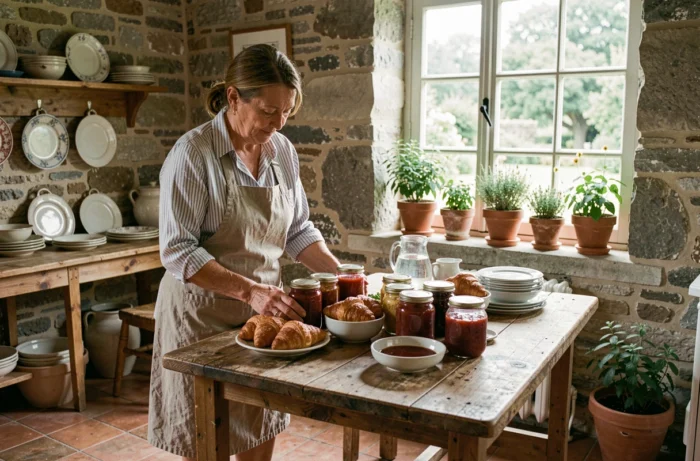
Hotel or Guesthouse: Comparative Table of Stay Criteria
Rather than listing generic advantages, this table contrasts the two options based on the criteria that matter when booking.
| Criterion | Hotel | Guesthouse |
|---|---|---|
| Capacity | No regulatory limit | Maximum 5 rooms, 15 guests |
| Breakfast | Additional charge (unless specific offer) | Included in the overnight stay |
| Welcome | Reception, dedicated staff | The host in person |
| Official rating | Stars (1 to 5), renewed every 5 years | No mandatory star rating |
| Check-in/check-out times | Reception often extended or 24/7 | To be agreed upon with the host |
| On-site dining | Restaurant, bar, room service possible | Table d’hôtes (optional, by reservation) |
| Anonymity | High | Low (spaces sometimes shared) |
This table highlights a structural gap. The hotel relies on the permanent availability of services, while the guesthouse operates on a domestic model, with its advantages (proximity, inclusion of breakfast) and its constraints (negotiable hours, no room service).
Breakfast and Schedule Flexibility: An Underestimated Gap
Breakfast crystallizes a difference that marketing descriptions tend to smooth over. In a guesthouse, it is included in the price, often prepared with local products, and served at a time set by the host. This format suits travelers who appreciate morning conviviality and a relaxed pace.
On the other hand, if you leave early or have dietary restrictions, the rigidity of the service can be problematic. Asking in advance about the time and arrangements for breakfast remains a useful precaution, rarely mentioned in booking guides.
In hotels, breakfast is generally charged extra, with a wider time frame and a buffet format. Flexibility is greater, but the total cost of the stay increases. For a stay of several nights, this accumulated difference weighs on the budget.
Hotel Ratings and Guesthouse Labels: Reliability of Quality Benchmarks
The hotel star system in France is based on specific criteria for equipment, surface area, and services. A three-star rating guarantees a baseline of services. However, the rating does not cover elements such as actual soundproofing or the quality of the welcome. Complementing this information with recent reviews remains relevant, particularly regarding accessibility and noise.
Guesthouses do not have a mandatory star rating. Some adhere to labels (Gîtes de France, Clévacances, Accueil Paysan), which impose their own specifications. These labels provide a benchmark, but their coverage and requirements vary from one network to another.
To decide between the two, here are useful checks to make before booking:
- Date of the last rating or label renewal, to ensure that the evaluation is still relevant
- Recent reviews on concrete criteria (cleanliness, noise, condition of bedding) rather than on the overall score
- Direct contact with the host to ask targeted questions about accessibility, facilities, or schedules
What Type of Traveler for Which Accommodation
The analysis of the differences between hotels and guesthouses outlines fairly clear usage profiles.
- Business traveler or in quick transit: the hotel offers extended reception, quick check-in, and flexible hours, suited to a tight schedule
- Couple or family on vacation seeking local immersion: the guesthouse offers direct contact with the host, personalized advice on the region, and architectural charm often linked to local heritage
- Traveler with specific constraints (reduced mobility, dietary regime, early departure): check the facilities and service flexibility before booking, regardless of the type of accommodation
- Tight budget for several nights: include the cost of breakfast in the total calculation, as the systematic inclusion in guesthouses can rebalance a higher displayed rate per night

The choice between a hotel and a guesthouse is made based on concrete criteria, not on brand image. The issue of included breakfast and schedule flexibility remains the most often overlooked factor, even though it affects both the budget and the actual comfort of the stay.