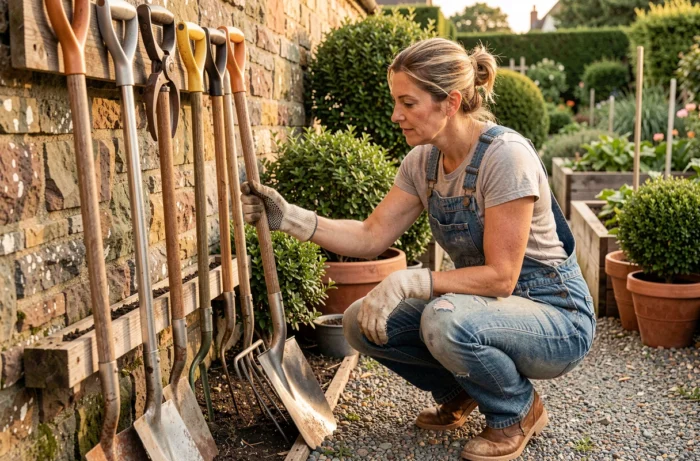
A garden needs care throughout all four seasons, and each one calls for different tasks: pruning, digging, mowing, watering and weeding. The gardening equipment you choose affects not only the quality of the work, but also how tiring it is and how long your tools last. Matching your tools to the soil, the plants you grow and the area to be covered is the foundation of effective year-round garden maintenance.
Repairability and lifespan: two factors to consider before purchase price
Most buying guides compare tools by price or brand. One more important factor often gets overlooked: whether a tool can be repaired rather than replaced.
A pair of secateurs with replaceable blades or springs will last several seasons longer than a one-piece model that costs a few euros less. The same applies to spade handles, rake heads and hedge-trimmer blades. Before buying, check whether spare parts are available for the model you have in mind.
Repairability matters for powered equipment, too. A lawn mower with a housing, blade or filter that can be replaced easily is a better long-term investment. The total cost of a tool is its purchase price plus the cost of replacing it sooner than expected. A repairable tool that costs more upfront often works out cheaper after three or four years.
To compare tools available on the market, the Info Jardinage gardening equipment section brings together different equipment categories and their technical specifications.
Soil-working tools: match the blade to the soil
Soil has a greater influence on tool choice than any other factor. Heavy, sticky clay calls for different equipment than light, sandy soil.
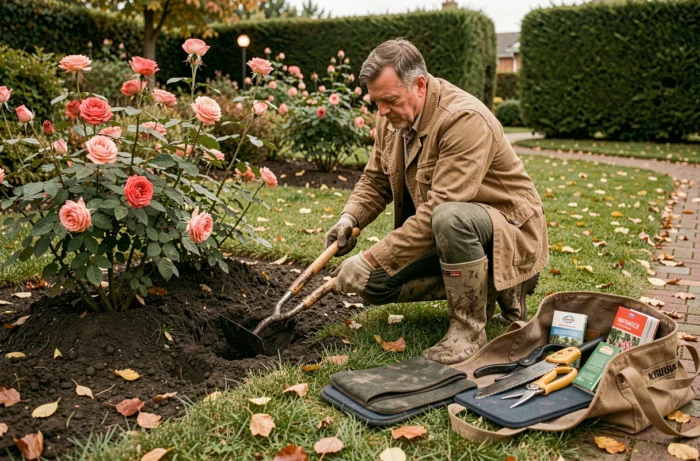
Spade, digging fork and broadfork
A standard spade is suitable for loose soil and small areas. In compacted soil, it takes more effort and quickly tires your back. A digging fork penetrates clay more easily with its tines, without turning over the deeper soil layers.
A broadfork loosens the soil without turning it over, preserving microbial life. In a vegetable garden, it is a useful alternative to a spade in soil that has already been worked. Using it involves a rocking motion that engages your legs rather than your back.
Hoe and garden claw
A hoe breaks up the surface crust, aerates the top few centimetres and cuts weeds. A garden claw, with its curved tines, is better suited to breaking up clods after digging or mixing in compost. Each tool is designed to work at a specific depth, and using them interchangeably means unnecessary effort.
Secateurs and pruning tools: choose according to branch diameter
Pruning is one of the most common garden tasks, from spring through autumn. The right tool depends directly on the diameter of the branches you need to cut.
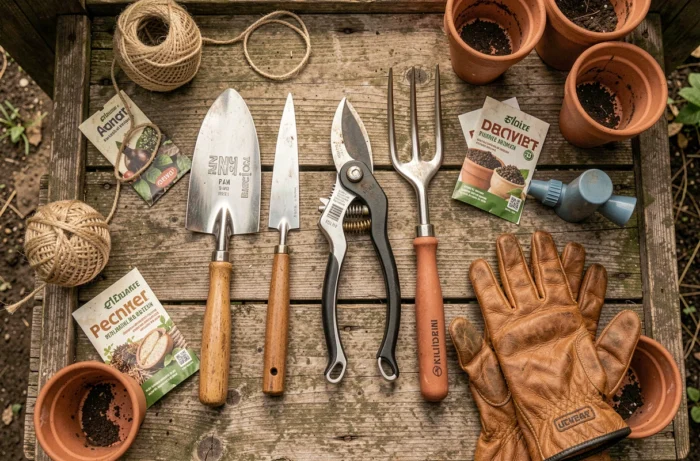
- Bypass secateurs (which make a clean cut as two blades slide past each other) are suitable for green shoots and small stems. They produce a clean cut that heals better, making them a good choice for roses, perennials and young growth.
- Anvil secateurs (with a blade that presses against a flat surface) require less force and are used on dead or dry wood, where a clean cut is less important.
- Loppers extend your cutting reach beyond what secateurs can manage. Their long handles provide leverage for medium-sized branches.
- A pruning saw is used for thicker branches. A Japanese-style pull saw blade requires less effort and produces a finer cut.
Using secateurs on a branch that is too thick can damage the blade and crush the wood, making it more vulnerable to disease. The right pruning tool is one with a cutting capacity suited to the branch you need to cut.
Watering and water restrictions: choose equipment that complies with local rules
Watering equipment should be chosen based on more than just the area to be covered. Water restrictions during dry spells vary by municipality and alert level, and may distinguish between different uses, such as lawns, vegetable gardens and flower beds.
The public VigiEau website lets you check the measures in force for each municipality and type of use. Investing in a programmable automatic watering system or drip irrigation only makes sense if its use is permitted locally when your garden needs it.
Rainwater harvesting: a useful addition, not a guarantee
Installing a rainwater collector reduces your reliance on the mains supply, but does not guarantee general permission to water during periods of restriction. Some prefectural orders set specific conditions for using rainwater, while others prohibit it for certain purposes just like mains water. Check the local order before investing in a storage system.
Drip irrigation is the most water-efficient method and is often still allowed during water-watch periods because it targets the root zone without waste. For a vegetable garden or flower beds, it is the first system to consider.
Lawn care: lawn mower and complementary tools
Lawns need regular care from spring through autumn. The right lawn mower depends on the size and layout of your garden.
For a small area, a manual reel mower is sufficient and gives a clean cut without noise or fuel. For areas of more than a few hundred square metres, you will need a petrol or electric mower (corded or battery-powered). Battery-powered mowers are suitable for medium-sized lawns and avoid the hassle of a power cord, but their runtime decreases over time.
Alongside mowing, a lawn scarifier aerates the grass in spring by removing accumulated thatch. A spreader distributes compost or soil improver evenly. Used once or twice a year, these two tools are enough to keep a lawn dense without resorting to chemical treatments, which have been banned for private individuals since 2019 for synthetic plant protection products.
One final point to keep in mind: clean, sharp tools work better and last longer. Cleaning blades after each use, oiling the joints on secateurs and emptying the mower housing at the end of the season are simple habits that turn a one-off purchase into long-lasting equipment.