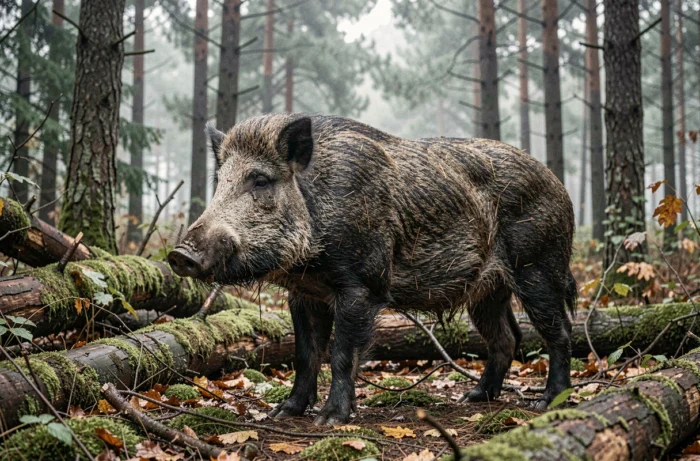
The wild boar known as “Attila” refers to large specimens primarily hunted in Turkey, in the mountainous regions of northern Anatolia. Often presented under the scientific name Sus scrofa attila, this giant wild boar has been part of hunting vocabulary for several decades. Its size far exceeds that of common European wild boars, making it a subject of fascination for hunters and naturalists.
Sus scrofa attila: a name without official taxonomic status
The first reflex when faced with an animal labeled as a subspecies is to check its place in the zoological classification. On this point, no recent scientific publication validates “Sus scrofa attila” as a recognized taxon.
The zoological databases published between 2020 and 2026 link the wild boar populations of Anatolia to forms such as Sus scrofa lybicus or related lineages. The term “Attila” does not appear in reference publications as a formal designation.
This does not mean that these Turkish wild boars are identical to Western European populations. Their size, morphology, and environment differ. However, labeling Attila as a “subspecies” is more a matter of commercial and hunting vocabulary than a classification validated by the scientific community. To delve deeper into the story of the Attila wild boar in Turkey, one must distinguish between popular narratives and the actual zoological framework.
This taxonomic ambiguity does not detract from the physical reality of the animal. Specimens taken from northern Turkey reach weights that French or German wild boars rarely approach.
Size of the Attila wild boar: why are Turkish wild boars so massive
Several factors converge to explain the exceptional size of Anatolian wild boars. The vast forested and mountainous territories of northern Turkey, particularly around the Samsun region, provide favorable conditions for the aging of animals.
A wild boar that ages without excessive predation pressure gains weight year after year. In Turkey, human density in mountainous areas remains low, and natural predation by wolves or bears is insufficient to limit the growth of the largest individuals.
Diet and mountainous terrain
The beech and oak forests of northern Anatolia produce considerable amounts of acorns and beechnuts. This abundant food resource, combined with a terrain that imposes intense physical movement, promotes muscle development and mass gain.
Wild boars that survive several harsh winters at altitude accumulate a body mass that their lowland counterparts do not reach. The terrain and food abundance explain the size, not genetics alone.
Absence of selection through intensive hunting
In Western Europe, hunting pressure often targets the largest individuals, which can reduce the average size of populations in the long term. In Turkey, hunting territories cover vast areas (several hundred thousand hectares in some concessions), which dilutes this pressure and allows more males to reach their full physical potential.
Expansion of wild boars in Europe and the place of the Attila wild boar in this dynamic
The Attila phenomenon cannot be understood in isolation. Recent multinational syntheses on wild boar populations in Europe show a clear trend: wild boar populations are increasing despite the decline or stagnation in the number of hunters.
This expansion dynamic concerns the entire continent, from the Iberian Peninsula to Anatolia. Wild boars are colonizing new territories, adapting to suburban environments, and benefiting from climate change, which softens winters and lengthens breeding periods.
- Increasing food availability (agricultural crops, waste in suburban areas) supports high population densities across the continent.
- The decline in the number of active hunters in several European countries reduces regulation through culling, including in rural Turkey.
- Recent genetic studies show differentiation between urban and rural wild boars, suggesting that distinct lineages may emerge depending on habitats, including in large Turkish cities like Istanbul.
The Attila wild boar is thus part of a broader context. Its exceptional size is not an isolated phenomenon, but the product of an environment that favors the maximum growth of a species experiencing demographic expansion.
Hunting the Attila wild boar in Turkey: a specific framework
The hunting of the Attila wild boar takes place mainly in the mountainous regions of northern Turkey, with a season that generally runs from early October to late March. Drives are the dominant mode of hunting in these territories.
The Turkish specificity lies in the cultural status of the wild boar. In a predominantly Muslim country, pork (and thus wild boar) is not consumed. Wild boars are not subject to any local food exploitation, placing them in a particular category: trophy game for foreign hunters, pests for farmers.
A market oriented towards international clientele
Hunting trips for the Attila wild boar target almost exclusively European hunters, mainly French, German, and Austrian. Several specialized agencies organize trips on large concessions, with accommodation and guidance provided by local guides.
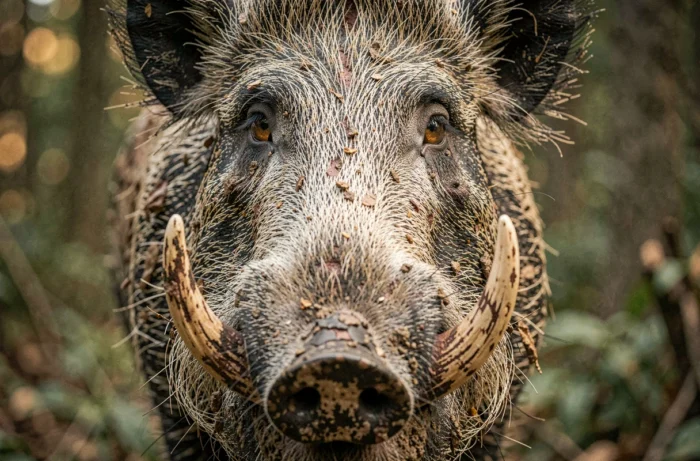
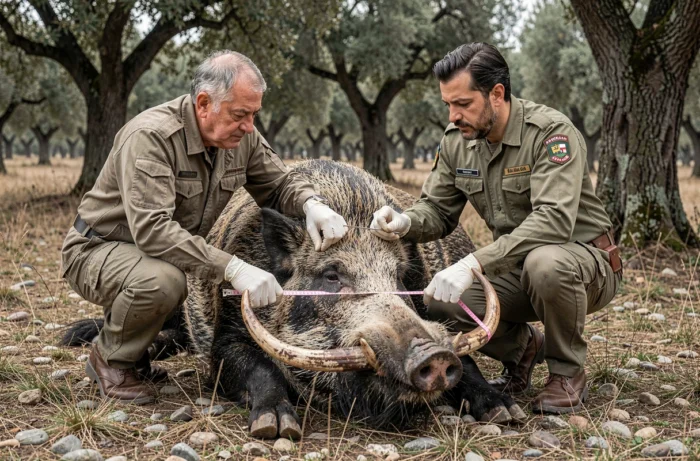
The sought-after trophies are the tusks, which can be remarkably long in older males. The weight of the animal is a secondary criterion but is always highlighted in the communication of the organizers.
Attila wild boar and genetic research: open questions
Recent genetic studies on European wild boars open avenues for reflection applicable to Turkish populations. The most recent genomic analyses have confirmed that urban and rural wild boars are genetically distinct within the same country.
This discovery, described as a “source-sink dynamic” between rural and urban environments, poses a direct question for Turkey: do the wild boars of the Anatolian mountains form a genetically differentiated lineage from those that frequent the peripheries of large Turkish cities?
No published study to date has specifically sequenced the DNA of “Attila” wild boars to compare them with other Turkish or European populations. This scientific gap leaves room for hunting narratives, which readily attribute almost mythical characteristics to these animals without genomic support.
The Attila wild boar remains, for now, an animal whose physical reality impresses as much as its scientific status remains unclear. Hunters and zoologists continue to speak of it in very different registers.