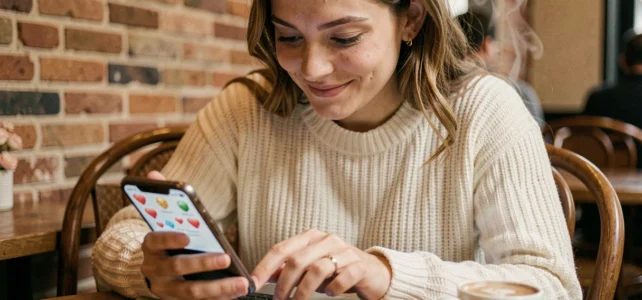
A red heart sent to a long-term partner does not carry the same weight as a red heart slipped into a first exchange on a dating app. Love emojis function as markers of intention, the meaning of which varies depending on the context, the platform, and the relationship between the two people. Understanding these variations helps avoid misunderstandings and read between the lines of your romantic messages.
When a love emoji changes meaning depending on the platform and context
Most online guides assign a fixed meaning to each emoji. The red heart would always signify passionate love, the purple heart spirituality, and the yellow heart friendship. This catalog reading overlooks a crucial parameter: the meaning of an emoji depends on the conversational context, not a universal code.
You may also like : The best online services to boost your business activity
A 🥰 (smiling face with hearts) sent after a photo of a cooked dish is not romantic at all. The same emoji placed in response to a “I miss you” expresses deep affection. The 🫶 (hands forming a heart), recent in the Unicode catalog, oscillates between friendly support and a declaration depending on the tone of the preceding message.
Display differences between platforms add a layer of complexity. An emoji may appear tender on iOS and more neutral on Android because the design of the pictogram varies from one system to another. When trying to understand the meaning of love emojis, it is essential to integrate this reality: the sender and the recipient do not always see the same thing.
Read also : The best digital marketing strategies to boost your business in 2024
The age of the couple also alters the reading. In the first weeks of a relationship, a simple ❤️ can trigger an adrenaline rush. After several years, the same red heart becomes routine punctuation, and sometimes its absence is what causes concern.

Colored heart emojis: what the shades convey in a couple
The Unicode catalog now includes several thousand emojis, and colored hearts hold a special place within it. Each hue carries connotations, but these are not set in stone.
The most used hearts in romantic messages
- The red heart ❤️ remains the most direct love emoji. An analysis of scheduled posts via Buffer in 2025 places it among the ten most used emojis across all categories. In a couple, it serves as much to say “I love you” as to validate a logistical message with warmth.
- The pink heart 🩷, recently added to the standard, expresses a softer tenderness, often associated with non-passionate affection. It frequently appears in exchanges between partners who prioritize companionship over overt romance.
- The fire heart ❤️🔥 marks an assumed intensity: desire, attraction, passionate energy. Its use remains more common at the beginning of a relationship or during reunions after a separation.
- The light blue heart 🩵, a recent addition to Unicode, is more about expressing a calm and comforting affection, often non-romantic. It slips into conversations between close friends or in a relaxed couple.
The brown heart and identity uses
The brown heart 🤎 illustrates an interesting shift. Initially perceived as just another colored heart, it is increasingly used as a marker of aesthetic affinity or identity. In a romantic context, sending it may signal a form of authenticity, a rejection of classic romance in favor of a more grounded connection.
Field feedback varies on this point: some see it as warm affection, while others view it as a simple visual preference without sentimental dimension. It is a good example of an emoji whose meaning can only be decoded by knowing the person who sends it.
Love face emoji: decoding smileys in couple texts
Hearts are not the only carriers of emotion in romantic messages. Face emojis carry nuances that hearts alone do not cover.
The 😍 (heart eyes) expresses visual enthusiasm, often triggered by a photo or news. It conveys admiration more than tenderness. The 🥰, on the other hand, communicates a feeling of emotional well-being, an inner warmth. The difference is subtle but real in the dynamic of an exchange.
The 😘 (face blowing a kiss) remains one of the most common emojis to close a message between partners. Its value oscillates between sincere declaration and a reflex of romantic politeness. When it disappears after months of daily use, this absence can create a micro-signal of alert in the couple’s communication.

Frequency and absence of emojis: what digital non-verbal communication reveals
The most revealing question is not “what emoji does my partner send,” but rather “how does its usage evolve over time.” A sudden change in emoji frequency can signal a shift in emotional state, long before words articulate it.
A partner who punctuated every message with a heart and gradually stops does not necessarily express disinterest. Mental load, fatigue, a change in professional rhythm can alter digital communication habits without affecting feelings.
On the other hand, the appearance of more distant emojis (the thumbs up 👍 replacing a heart, for example) deserves attention. This shift in register, from romantic to functional, serves as an indicator that the psychology of digital communication is beginning to document.
The available data do not allow us to conclude that a particular emoji predicts the strength of a relationship. However, the consistency between verbal tone and non-verbal tone (emojis, punctuation, response time) remains a reliable marker of the quality of an exchange. A love message without any emoji is not less sincere than a message filled with hearts – it all depends on what constitutes the norm in your couple.
Each relationship builds its own visual vocabulary. Rather than seeking a universal dictionary of romantic emojis, observing how your partner uses these symbols over time provides a much more accurate reading of their intentions and feelings.