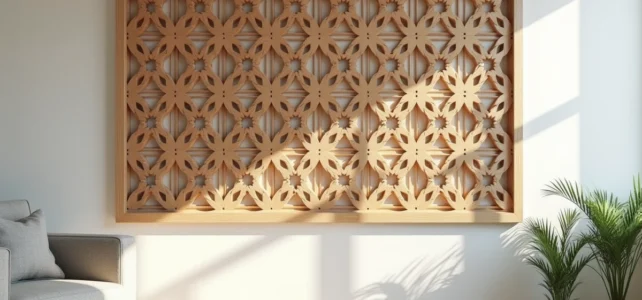
The moucharabieh is a perforated panel made up of small pieces of wood assembled without nails or screws according to a repetitive geometric pattern. Originally used in Islamic architecture to filter light and ventilate rooms, this device has now been transformed into a decorative interior screen. Making your own requires few tools, but a selection of materials and an assembly method suited to the intended use.
Choosing the Right Wood Species for a Durable Interior Screen
The wood determines both the strength of the moucharabieh and its behavior over time. A panel placed against a living room wall does not undergo the same stresses as a freestanding partition. The choice of species also affects the ease of cutting, a key criterion when working with consumer-grade tools.
Read also : How to Successfully Design Your Green Spaces for a Harmonious Garden
Beech and oak are suitable for structural screens (partitions, stair railings). Their hardness makes cutting slower, but the result withstands impacts and does not warp. For a purely decorative panel, fixed to the wall or set as a picture, poplar or MDF offers quicker work and a lower cost.
Before starting, check that the chosen panels or battens are well-dried and stored flat. Wood that is still damp will warp after assembly, and the geometric patterns will lose their regularity. For those who wish to make a DIY wooden moucharabieh with a professional finish, the calibration of the pieces begins at this selection stage.
Further reading : Practical Guide: How to Easily Reset Your La Crosse Weather Station

Tracing and Cutting the Geometric Patterns of the Moucharabieh
The geometry of the moucharabieh is based on the repetition of a module. Diamonds, squares on points, eight-pointed stars: each pattern is constructed from a unique template reproduced across the entire surface. The precision of the template determines the final result much more than the complexity of the chosen design.
Designing a Reusable Template
Cut your base module from thin plywood or stiff cardboard. Trace it with a pencil on graph paper before transferring it to the template material. A simple-shaped module (hollow square, diamond) facilitates initial trials.
Then transfer the template onto each batten or board by marking the areas to be hollowed out. Always align the template along a reference edge so that the patterns connect seamlessly once the pieces are assembled.
Cutting Tools Suitable for Home DIY
The jigsaw remains the most accessible tool for hollowing out geometric shapes in softwood or MDF. Drill a starter hole inside each area to be hollowed out, then insert the blade to follow the line. On hardwood, a router equipped with a straight bit provides sharper edges.
- Jigsaw with fine blade (tight teeth): suitable for MDF and poplar, curved trajectory possible
- Router with guide template: precise results on oak or beech, requires some practice
- Scroll saw: ideal for small decorative panels and complex patterns (stars, arabesques)
Sand each cut with medium-grit sandpaper, then fine grit. Chips on the inner edges are the most visible defect on a moucharabieh: take the time to eliminate them before assembly.
Assembling and Fixing a Moucharabieh Panel Without Heavy Structure
The traditional assembly relies on the interlocking of small turned pieces, without glue or nails. In the DIY version, the most reliable method combines wood glue and reinforcement with dowels. This technique maintains the alignment of the modules while remaining dismountable if needed.
For a freestanding screen (room divider, for example), frame the perforated panel in a frame of solid battens screwed at the corners. The frame stiffens the whole and provides fixing points to the wall or floor. Without a frame, a large perforated MDF panel will sag under its own weight.
Fix the panel to the wall with invisible brackets screwed to the back of the frame. Two brackets at the top and two at the bottom are sufficient for a medium-sized panel. If the moucharabieh serves as a partition, also anchor it to the ceiling with a U-shaped rail to prevent any tipping.
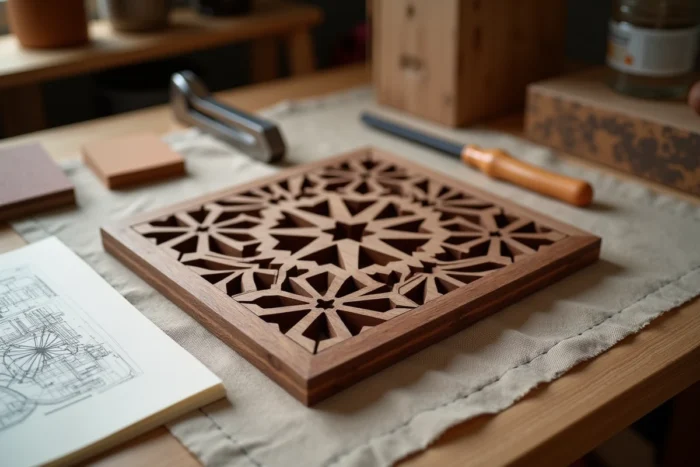
Finishing and Surface Treatment for a Decorative Wooden Moucharabieh
The finish protects the wood and defines the style. A matte varnish preserves the natural look of oak or beech. An opaque paint (white, black, muted tone) modernizes the panel and integrates it into contemporary decor. The choice of treatment also affects long-term maintenance.
On MDF, apply a primer before any painting: the porous surface absorbs the product unevenly without this preparation. On solid wood, fine sanding followed by a hard oil is sufficient for a warm finish.
Ecological Impact of Wooden Screens: What DIY Does Not Resolve
Several French-speaking architects and designers remind us that multiplying wooden coverings does not automatically make a project ecological. The origin of the species, the chemical treatments applied, and transportation weigh heavily in the carbon footprint of a decorative screen.
A French oak moucharabieh certified PEFC has a very different impact from an imported exotic wood panel without traceability. MDF, often presented as economical, contains resins whose composition varies by manufacturer. Reading the technical data sheet of the panel before purchase allows you to identify binders based on formaldehyde.
- Prefer a local species (beech, oak, poplar) with sustainable management certification
- Check the emission class of the MDF: class E1 limits formaldehyde emissions in indoor air
- Avoid solvent-based stains and varnishes indoors: opt for water-based products
- Reuse wood scraps or reclaimed floorboards for small decorative panels
Integrating the moucharabieh into a comprehensive thermal comfort strategy gives it a function beyond decoration. Positioned in front of a south-facing bay window, a wooden screen filters direct light and reduces summer overheating, just as in its original architectural use.
The DIY moucharabieh remains an accessible project with common DIY tools. The difficulty lies less in the technique than in the accuracy of the tracing and the choice of suitable wood. Asking about the origin and treatment before the first cut is already making a more coherent object than most screens sold in kits.