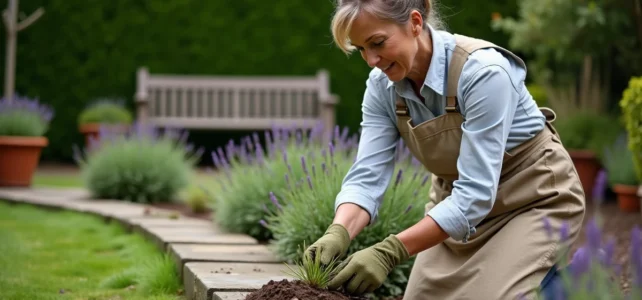
A successful green space design relies less on the choice of plants than on understanding the soil and managing water flow. We regularly observe gardens where the plant palette is impeccable, but where poor drainage ruins everything in just two winters. Before drawing anything, the substrate, slope, and water regime of the land dictate every decision.
Soil Permeability and Rainwater Management in a Garden
Since 2023, more and more French municipalities are imposing a reduction in impermeable surfaces in development projects, including for private gardens. Solid concrete terraces, mortar-jointed slabs, asphalted parking lots: these surfaces concentrate runoff and overload drainage systems. The permeability of the soil determines the sustainability of the entire project.
Related reading : How to Easily Make a Wooden Mashrabiya to Decorate Your Interior
We recommend addressing this point right from the master plan. Stabilized gravel on geotextile, permeable pavers with grass joints, and cellular slabs allow water to pass through without sacrificing usability. On clay soil, a foundation layer of calibrated aggregate (type 0/31.5) improves drainage under traffic areas.
A landscape designer who proposes materials first without conducting a percolation test misses the point. On the site www.jamet-espaces-verts.fr, the design logic starts precisely from this technical reading of the land, which avoids costly revisions later.
Related reading : How to Organize Stress-Free Installment Payments for a Move
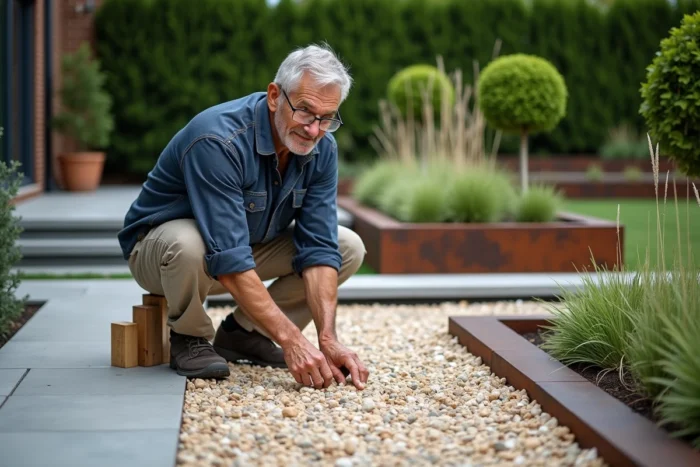
The ratio between permeable and impermeable surfaces should be included on every garden plan. An excess of terrace or concrete driveway turns even the slightest rain into stagnant water at the foot of the flower beds. We prefer to work with a clear objective: to limit impermeabilization to the strictly necessary portion (accessible pathways, door thresholds, technical shelters).
Pesticide-Free Plant Selection: Robust Plants and Structuring Mulch
The ban on pesticides for individuals, which came into effect in 2019, has changed the game more profoundly than most articles on harmonious gardening suggest. Without synthetic molecules, varieties sensitive to powdery mildew, aphids, or rust become unmanageable for amateur gardeners.
A harmonious garden now relies on plants that can defend themselves. We guide our choices based on specific criteria:
- Intrinsic resistance to local pathogens, verifiable on the variety sheets from breeders (indicated as “resistant” or “tolerant” to certain diseases)
- Ground cover capacity to limit the emergence of weeds, reducing manual weeding to just a few annual passes
- Compatibility with a thick organic mulch (fragmented branch wood chips, miscanthus, pine bark) that nourishes the soil while blocking light to unwanted seeds
Mulching is not a decorative accessory. It is a technical tool for biological pest management and water regulation. A sufficiently dense layer, renewed each year at the end of winter, reduces watering and gradually improves soil structure through decomposition.
Diverse Hedges Rather Than Monospecific Ones
The hedge of thuja or cherry laurels remains a common reflex. In the absence of chemical treatment, a hedge composed of a single species poses a concentrated health risk: if a pathogen attacks it, the entire linear hedge fails.
A mixed hedge of five to seven deciduous and evergreen species better absorbs fluctuations. It also offers staggered flowering, berries for beneficial wildlife, and a more natural landscape appearance, in line with the current trend of resilient gardens.
Functional Zoning of the Land: Circulation, Rest, and Production
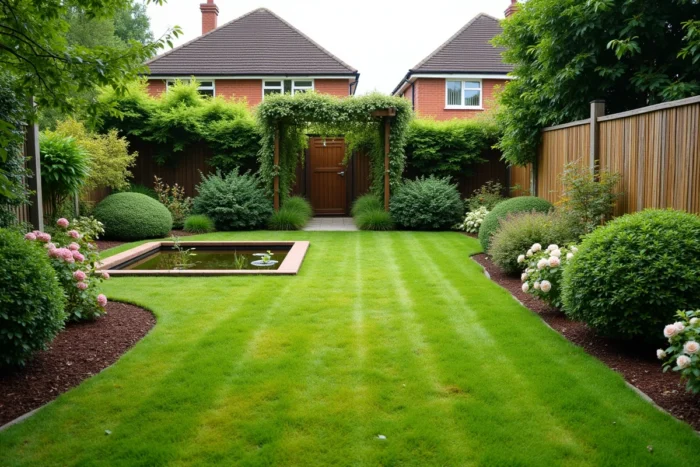
The garden plan is not just about placing a flower bed here and a terrace there. Zoning starts from the actual uses of the land. We distinguish three types of flows that structure the space:
- Utility circulations (gate to front door, access to the trash area, passage to the vegetable garden), which must remain passable in rainy weather and winter
- Rest areas, positioned according to seasonal sunlight and protection from prevailing winds, not simply “at the back of the garden”
- Production areas (vegetable garden, composter, rainwater collector), grouped to limit back-and-forth trips and facilitate maintenance
- Buffer zones (flowering meadows, grassy strips), which serve as both visual transitions and corridors for pollinators
The vegetable garden should be placed as close as possible to the water source and the kitchen. A vegetable garden relegated thirty meters from the house ends up abandoned by the second season. The distance of use is a design parameter as crucial as exposure.
Proportions and Lines of Flight
A garden appears harmonious when the proportions between empty and filled spaces are mastered. We apply a simple principle: the lawn or central mineral surface occupies about one-third of the total area, the flower beds and hedges another third, and the final third is divided between built structures (terrace, shelter) and transition areas.
Lines of flight guide the eye. A slightly curved path that disappears behind a flower bed creates a depth that a straight line does not allow. This is not a question of style; it is spatial perception applied to the landscape.
Sustainable Maintenance: Designing a Garden That Ages Well
A landscape design that does not anticipate maintenance generates additional costs starting in the third year. The best indicator of a well-designed garden is its annual maintenance time, not its appearance on the day of delivery.
Fast-growing shrubs (buddleia, eleagnus) are initially appealing but require two to three prunings a year to stay within their limits. We recommend cross-referencing the annual growth rate with the adult size before any planting. A shrub that reaches its final volume in five years without pruning is preferable to a spectacular specimen that must be constantly contained.
The choice of grass illustrates the same principle. A mix of tall fescue and English ryegrass tolerates moderate drought and requires fewer mowings than a fine grass type like agrostis, which yellows at the first dry spell without automatic watering.
Green space development does not end with planting. A harmonious garden is a living system whose design integrates soil, water, plants, and human use into a single logic. Neglecting any one of these parameters compromises the balance of the others.