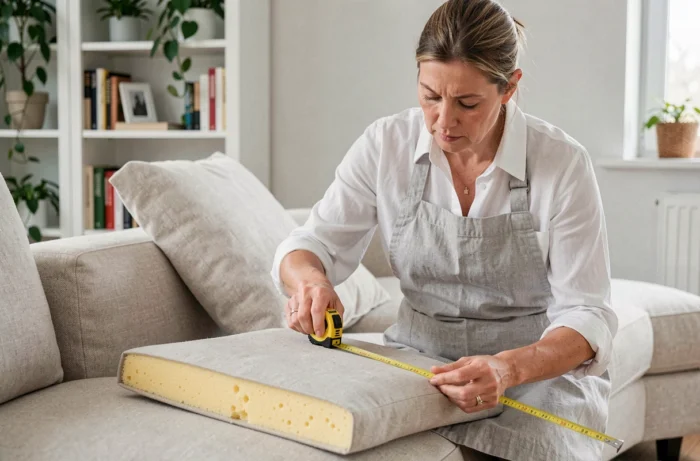
Replacing the foam in a Poltronesofa couch seems straightforward on paper: measure, order, insert. In practice, several technical errors turn this operation into a loss of comfort, or even degradation of the structure. This article isolates the most common friction points and compares them to the manufacturing specifics of Poltronesofa.
Poltronesofa Foam and Artisan Structure: What Design Requires for Replacement
Poltronesofa sofas are hand-assembled in Italy, with dimensional tolerances specific to artisan manufacturing. The official maintenance booklet of the brand specifies that the dimensions of the products are indicative and cannot serve as a basis for a dispute. In practice, two sofas of the same model may have discrepancies of a few millimeters in the seat or backrest.
This variability has a direct consequence: transferring the measurements of a standard foam block found online without measuring the old foam in situ almost guarantees a fitting defect. A block that is too narrow will move in the cover, while a block that is too wide will deform the fabric covering and create permanent creases.
Before ordering, knowing how to replace Poltronesofa couch foam prevents neglecting this measurement step on-site, which conditions the rest of the operation.
Foam Density and Resilience: Table of Common Errors
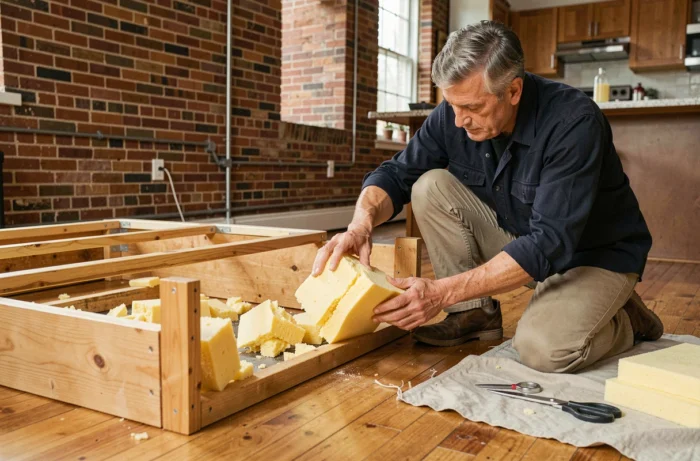
The confusion between density and firmness remains the most documented trap. Density, expressed in kilograms per cubic meter, measures the amount of material in a given volume. Firmness refers to the resistance to compression when touched. Two foams of the same density can offer very different sensations.
| Common Error | Consequence on the Couch | Correction |
|---|---|---|
| Choosing a standard low-density polyurethane foam | Rapid sagging, lifespan reduced to a few years | Opt for High Resilience (HR) foam for the seat |
| Confusing density and firmness | Dense foam but too soft, or firm but compresses quickly | Check both parameters on the technical sheet |
| Using the same foam for seat and backrest | Backrest too rigid, loss of back comfort | Softer and less dense foam for the backrest |
| Ignoring original thickness | Seat too high or too low, tension on the covering | Measure the old foam decompressed, not compressed in the cover |
High Resilience foam is distinguished by its ability to regain its original shape after compression. On a couch used daily, HR foam retains its properties significantly longer than standard polyurethane foam. The technical sheet must explicitly mention “HR” or “non-deformable expanded polyurethane”.
Replacing Foam on Non-Removable Poltronesofa Couch
Several Poltronesofa models do not have an accessible zipper. The brand’s maintenance booklet clearly distinguishes removable models from others and specifies that removing the covering on a model not intended for this purpose may damage the seams and internal fastenings.
On a non-removable model, the intervention requires partially unpicking the fabric or leather, then reattaching it properly. This is an upholstery operation, not a DIY task.
- Check in the Poltronesofa booklet if your model is classified as “removable” before any manipulation
- On a modular model, each module detaches individually, which simplifies access to the foam
- Never force the staples or seams connecting the structure and covering: a tear in the fabric at this level is irreparable without complete reupholstering
A non-removable couch that is poorly reopened often loses more in aesthetics than it gains in comfort. If you have no experience in upholstery sewing, an upholsterer will charge for this service at a cost much lower than replacing the couch.
Legal Warranty and Right to Repair: What Changes Since July 2026
The European directive 2024/1799 on the right to repair, transposed into French law by July 31, 2026, modifies the balance of power between buyer and seller. If a seating defect appears during the legal two-year warranty, you can demand repair (foam replacement) rather than an exchange of the entire couch.
The point that most guides omit: by choosing repair, the legal warranty is extended by 12 months from the date of repair. If the seller insists on a replacement when you requested a repair, the two-year warranty starts over from scratch.
However, this protection only covers the legal warranty. If you replace the foam yourself with a block purchased elsewhere, you step outside the manufacturer’s warranty. The timing of the decision matters: having Poltronesofa confirm the defect before any personal intervention preserves your rights.
Errors on the Covering and Post-Replacement Maintenance
New foam exerts a different pressure on the covering. In the first few days, unusual creases or tensions may appear, especially on leather. The Poltronesofa booklet recommends not exposing leather coverings to direct sunlight and avoiding contact with aggressive substances.
After replacement, regularly turning and swapping the seat cushions (on models that allow it) remains the most effective maintenance gesture to homogenize the wear of the new foam. The phenomenon of creeping, this residual deformation that accumulates over time, then spreads over the entire surface rather than concentrating in the usual seating area.
- Vacuum the surface of the fabric or leather before putting the cover back on to prevent abrasive particles from getting trapped between the foam and covering
- Do not wash the cover at a temperature higher than that indicated on the Poltronesofa label, under penalty of shrinkage making reassembly impossible
- Allow the new foam to air out for a few hours before insertion so that it reaches its nominal volume
Replacing foam on a Poltronesofa couch is not a risky operation, provided the specific artisan manufacturing characteristics of the model are respected. Precise measurement on-site and the choice of suitable HR foam separate a successful renovation from a disappointing result. For models still under warranty, the new repair directive offers an additional lever to activate before reaching for the cutter.