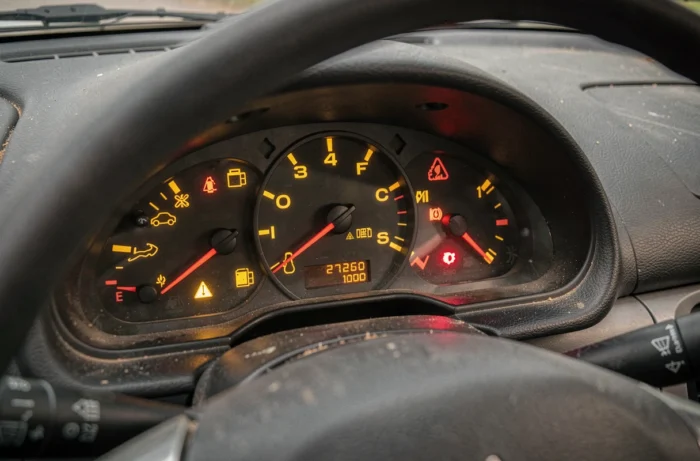
The dashboard of the Peugeot 206 features several dozen warning lights, each connected to a specific sensor or control unit. Their activation indicates a measured state of the vehicle: oil pressure, coolant temperature, or a fault detected by the engine control system. Understanding these dashboard lights on the Peugeot 206 allows one to distinguish between simple operational information and an alert that requires immediate stopping.
BSI Failures on Peugeot 206: When Lights Illuminate Without Apparent Reason
Even before analyzing each symbol, one phenomenon deserves attention on this model. The intelligent service box (BSI), which centralizes the vehicle’s electrical management, is a component known for its failures in the PSA family. Several independent garages report recurring BSI failures that cause ghost lights: lights that illuminate randomly, frozen gauges, electrical functions that temporarily disappear.
On an aging 206, this type of failure is common. The diagnosis then becomes complex, as the problem does not originate from the system indicated by the light, but from the box itself. An engine or ABS light flashing without apparent logic, especially if accompanied by multiple electrical malfunctions, points to a BSI fault rather than an isolated mechanical failure.
To delve into each symbol and its meaning, the list of lights and explanations for the Peugeot 206 dashboard details the cases one by one. The table below focuses on the most critical lights and the actions to take based on their color.

Red, Orange, and Green Lights on Peugeot 206: Comparative Table of Urgency Levels
The color code of warning lights follows a standardized logic in the automotive industry. On the 206, this hierarchy directly determines whether you can continue driving or not.
| Color | Urgency Level | Examples on 206 | Action |
|---|---|---|---|
| Red | Immediate stop recommended | Oil pressure, engine temperature, braking, airbag | Turn off the engine as soon as possible, do not continue driving |
| Orange | Short-term diagnosis needed | Engine light (injection), ABS, fuel alert, pollution control | Reduce engine load, plan a visit to the workshop |
| Green / Blue | Operational information | Low beam, turn signals, high beams (blue) | No action required, confirmation of activation |
The distinction between red and orange is the key data. A red light signals a risk of engine damage or failure of a safety system. In contrast, an orange light generally allows for reaching a garage within a reasonable time, provided the vehicle is not overworked.
Engine Light On Peugeot 206: Consequences at Technical Inspection
The orange engine light (often referred to as the injection light) is the one that generates the most questions. On the 206, it lights up when the control unit detects an anomaly in the ignition, injection, or pollution control system.
Since the reform of May 2018, an illuminated engine anomaly light while the engine is running constitutes a major failure at the technical inspection. The vehicle then receives an unfavorable notice with a requirement for a follow-up visit within two months. This rule also applies to ABS, airbag, and braking system lights.
For a 206 owner, the implications are concrete:
- An illuminated engine light caused by a simple lambda sensor fault or a clogged EGR valve is enough to trigger a follow-up visit, even if the vehicle runs normally
- An airbag light that remains illuminated is now classified as a safety defect, which was not systematically penalized before 2018
- The cost of repairs to turn off the light can vary significantly depending on the actual source of the fault, hence the importance of an accurate diagnosis before any intervention
Driving with an illuminated orange light is not prohibited by traffic regulations. However, the technical inspection now penalizes most safety lights that remain illuminated.
Diagnosis of Peugeot 206 Lights: OBD Scanner or Manual Reading of Fault Codes
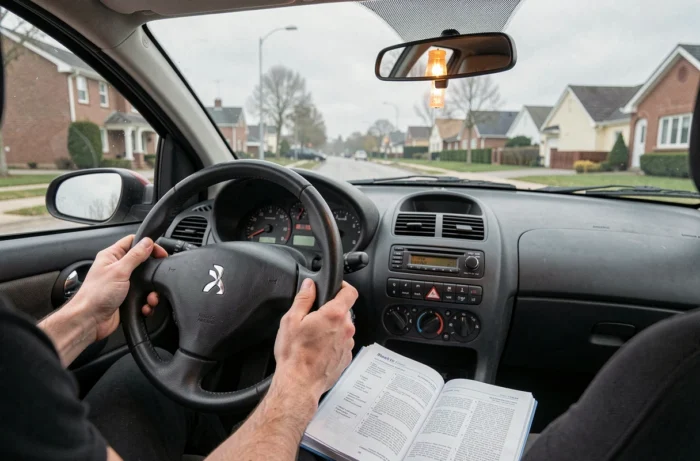
The 206’s control unit records fault codes (OBD codes) each time a light illuminates. These codes allow for precise identification of the component or circuit involved, without randomly replacing parts.
Reading Fault Codes with an OBD Scanner
The OBD-II diagnostic port is located under the steering wheel on the driver’s side. A basic diagnostic scanner allows you to read the recorded code and erase the light if the fault is resolved. On the 206, the most common codes relate to the injection circuit and temperature sensors.
Clearing a code without repairing the cause temporarily makes the light disappear. It will illuminate again as soon as the control unit detects the anomaly once more, sometimes after just a few kilometers.
Lights That Remain On After Repair
On 206s equipped with a faulty BSI, it sometimes happens that a light persists even after replacing the faulty part. In this case, a BSI reset or control unit reprogramming is necessary. Some specialized PSA garages offer this operation, which requires a diagnostic tool compatible with Peugeot’s proprietary protocol.
Oil Pressure and Engine Temperature Light: The Two Alerts Never to Ignore on a 206
Among all the dashboard lights, two require immediate engine shutdown: the oil pressure light (red oil can symbol) and the coolant temperature light (red thermometer).
Driving for more than a few minutes with the oil pressure light on can cause engine seizure. Lack of lubrication leads to metal-on-metal friction in the crankshaft bearings, a damage often irreparable on this type of engine.
The temperature light operates on the same logic. Prolonged overheating deforms the cylinder head gasket, leading to a mixture of water and oil and a loss of compression. On a 206 with a 1.4 or 1.6 petrol engine, the cost of replacing a cylinder head gasket often exceeds the residual value of the vehicle.
The best practice remains simple: red light on, engine off. Check the oil and coolant levels before any restart. If the levels are correct and the light persists, have the vehicle towed rather than attempting to reach a garage under its own power.