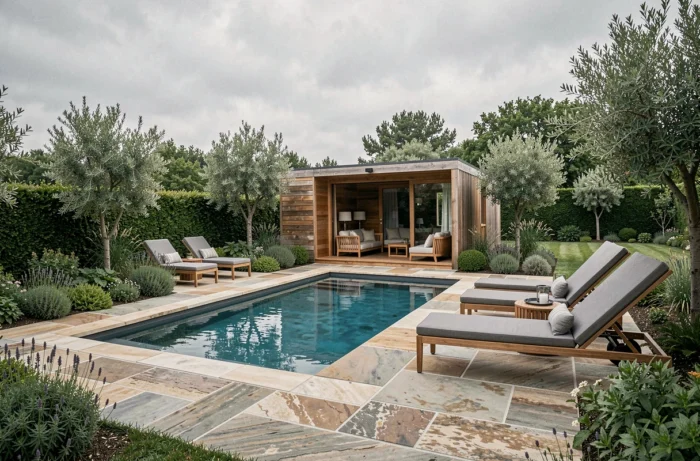
Pools smaller than 10 m² now represent 20 to 25% of sales among the majority of French builders. This shift towards compact pools, designed as aquatic lounges, redefines how we landscape a garden. Mineral beaches, vegetative lagoons, submerged lighting: technical and aesthetic choices have multiplied, and each configuration meets a specific use.
1. Micro-pool for small urban gardens
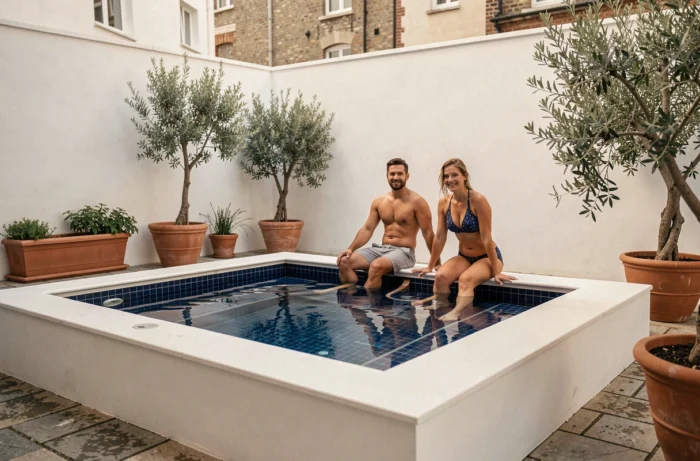
The aperitif pool, less than 10 m² in surface area, transforms a courtyard or city garden into a social space. The pool is not for swimming: you dip your feet in, place a drink, and chat with your feet in the water.
This format reduces administrative constraints (no building permit required for under 10 m²) and limits water consumption during filling. To explore other ideas for modern pool landscaping, choosing the interior finish (anthracite gray, deep green) is enough to give the pool a strong character without taking up much space.
The main limitation remains family use: with children, a pool of this size does not replace a traditional pool.
2. Natural swimming pond with vegetative lagoon
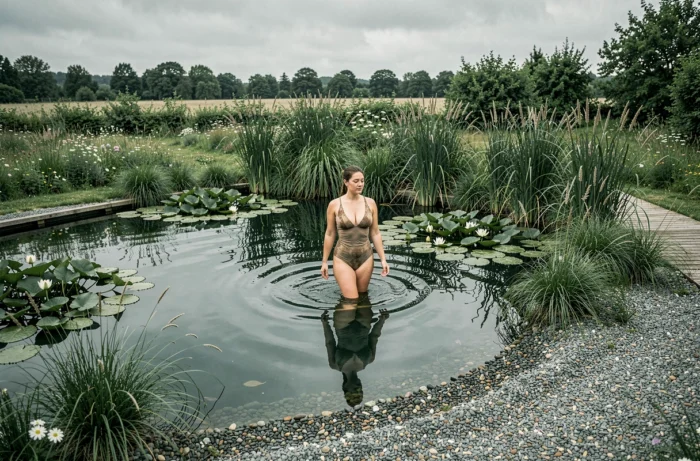
The principle is based on two distinct areas: a swimming basin and a planted area with aquatic plants that continuously filter the water. No chemicals, no chlorine, and a pump noise reduced to a minimum, or even nonexistent in gravity systems.
Landscapers are increasingly installing these natural ponds without a traditional technical room. The result integrates into the garden as a landscaped water feature, not as a strict pool.
Field feedback varies on the actual ease of maintenance: managing algae in the height of summer and maintaining biological balance requires regular monitoring, especially in the first two years.
3. Elevated composite wood terrace around the pool
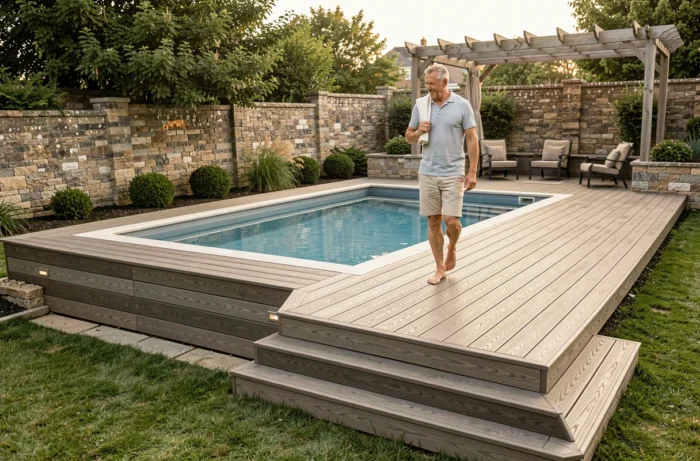
Composite wood (a blend of wood fibers and resin) offers a look close to natural wood without the constraints of annual maintenance (sanding, staining). The boards are laid on joists, allowing for the creation of an elevated beach that hides the coping and gives the effect of a sunken pool.
The composite does not heat up as much as natural stone in full sun, a factor that changes barefoot comfort in summer. However, dark shades remain warmer than light ones: the choice of color has a direct impact on use.
4. Submersible LED lighting and perimeter marking
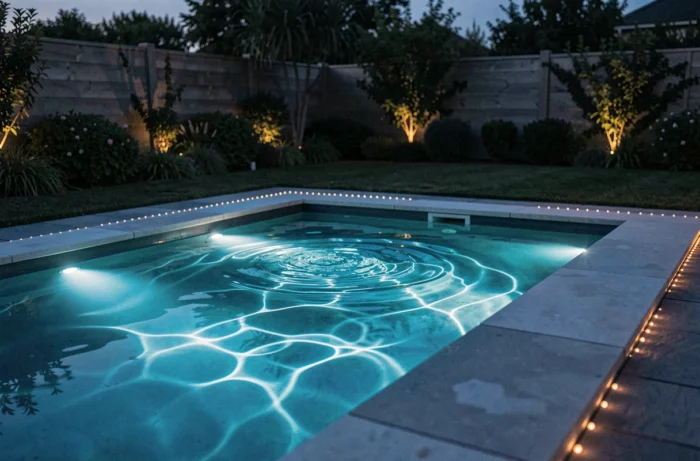
LED lighting in the pool extends the use of the pool after sunset and radically changes the garden’s ambiance. Submersible lights with color variation (warm white, blue, amber) can be controlled from a smartphone.
The perimeter marking, embedded in the terrace or coping, also serves a safety function by delineating the edge of the pool at night. It should be noted that regulations already require a certified safety device (barrier, alarm, cover, or shelter) for any inground or semi-inground pool.
5. Mediterranean plants in structured beds
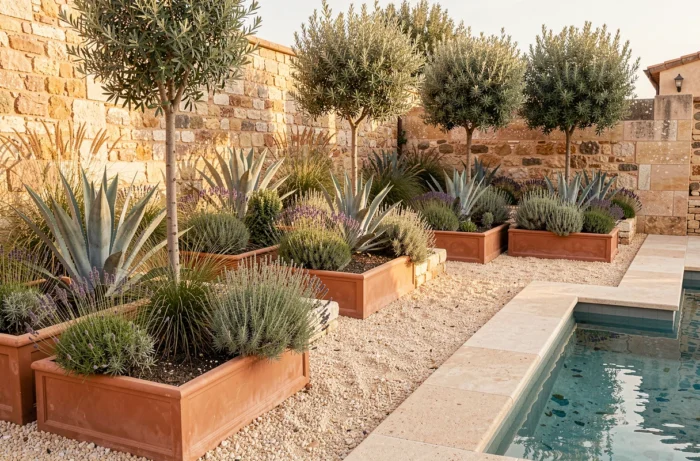
Lavender, agapanthus, ornamental grasses like miscanthus: these plants tolerate the heat reflected by water and paving without suffering. A structured bed in three layers (ground cover, low shrub, tall grass) creates visual depth without projecting too many leaves into the pool.
Evergreen species limit autumn cleaning. Deciduous or fruit trees (olive, fig) planted too close to the pool increase maintenance interventions.
6. Compact swim lane of 3 x 7 meters
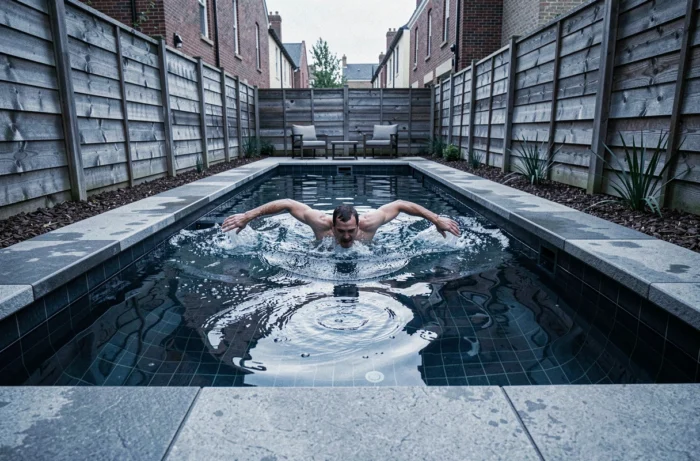
A swim lane of 3 x 7 m is sufficient for regular swimming while occupying a modest footprint. The narrow and elongated shape fits along a fence wall or at the edge of a garden, where a traditional pool would not fit.
This format directs the layout towards a clean and linear style: thin coping, no diving board, low vegetation on one side only. The swim lane imposes its rhythm on the garden rather than blending into it.
7. Wooden frame pool house for storage and summer kitchen
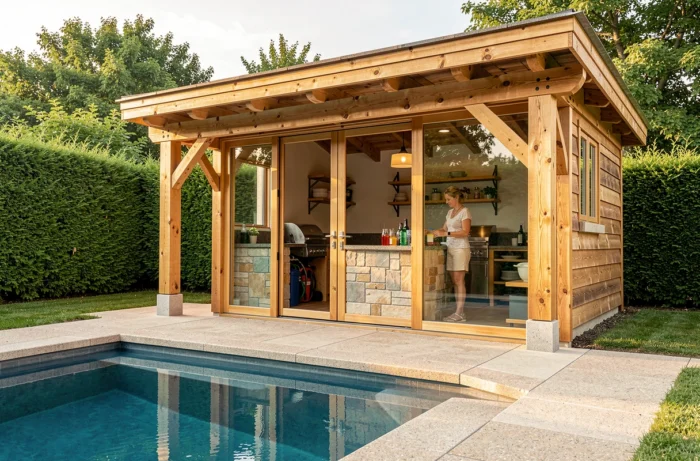
A pool house of a few square meters, made of wooden frame, concentrates the technical room, storage for pool accessories, and a water point. By adding an outdoor work surface and an integrated barbecue, it becomes a functional summer kitchen.
The orientation of the pool house relative to the sun and prevailing wind conditions the actual comfort. A shelter facing directly west overheats in the afternoon, while a northeast positioning protects from winds without blocking light on the pool.
8. Natural stone coping (travertine, porcelain stoneware)
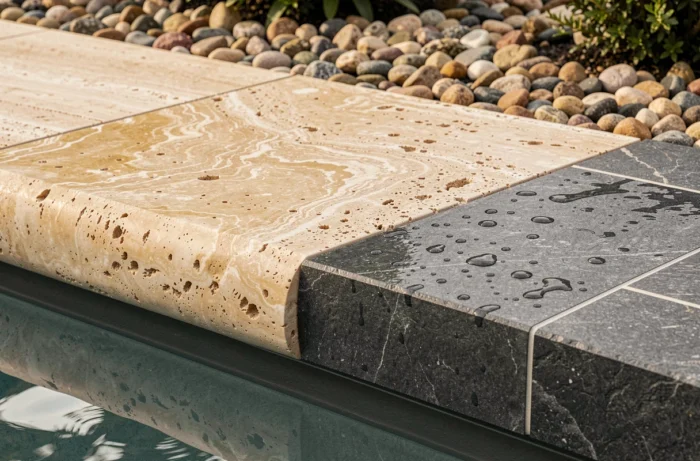
Travertine and porcelain stoneware remain the most commonly used materials for coping. Their non-slip finish limits the risk of slipping, and their thermal mass retains less heat than raw concrete.
Travertine stains more easily than porcelain stoneware: splashes of sunscreen or drinks leave marks if the stone is not treated with a water-repellent at installation. Porcelain stoneware, nearly impermeable, requires less long-term maintenance.
9. Garden furniture in aluminum and textilene
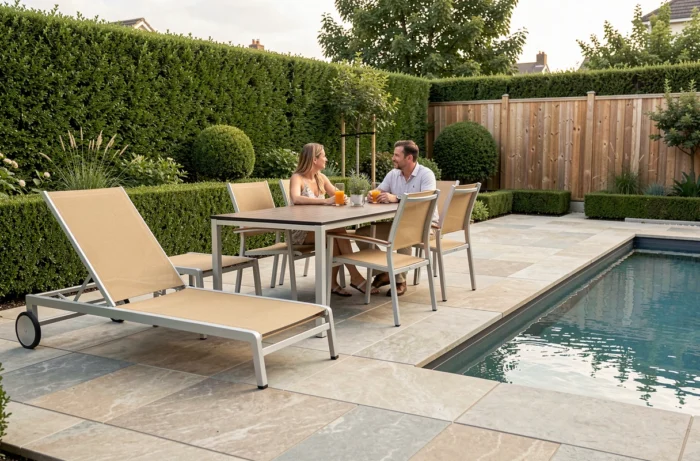
Aluminum does not rust when exposed to chlorinated splashes, and textilene (stretched synthetic fabric) dries in a few minutes. This duo dominates poolside furniture for practical reasons: it resists UV rays, does not mold, and can be cleaned with a hose.
- Stackable sun loungers to save space off-season
- Laquered aluminum coffee table, matching the deck chairs
- Hanging chairs on a frame, fixed away from the coping to prevent tipping
10. Triangular shade sail stretched above the beach
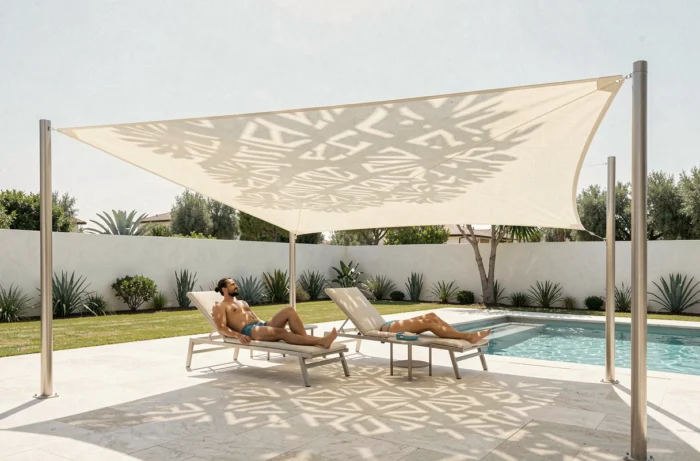
A shade sail made of technical fabric (high-density polyethylene or coated polyester) creates a cool area without heavy structure. Fixed at three points (pole, facade, post), it can be taken down at the end of the season and costs less than a pergola.
The height of the fixing determines the actual shaded area: if too high, the shade retreats and misses the beach during hot hours. An angle of inclination of about 25 to 30 degrees optimizes coverage between noon and 4 PM.
Water restrictions related to drought, reinforced in 2026 in several departments, remind us that the choice of pool and its landscaping is not limited to aesthetics. The volume of water, the filtration method, and the materials condition both the enjoyment of use and regulatory compliance.