A plot of 300 m² with a hedge, a square vegetable garden, and a lawn facing south cannot be managed with the same equipment as a balcony filled with planters. The choice of an irrigation system depends first on physical constraints (water pressure, elevation, soil type) before considering a brand. Jardinic, Gardena, Rain Bird, or Kärcher offer ranges that overlap on paper, but the differences become apparent in practice.
The durability of the fittings, the precision of the timer, and compatibility with current water restrictions make the real difference.
Water pressure and actual flow rate: the test that no one does before buying
Before comparing catalogs, connect a pressure gauge to the outdoor tap. Most consumer irrigation kits work properly between 1.5 and 4 bars. Below that, rotary sprinklers struggle to cover their advertised radius. Above that, low-quality fittings leak after one season.
Jardinic includes a pre-set pressure reducer in several of its kits, which avoids having to buy the part separately. At Gardena, the reducer exists but is sold as an accessory. At Rain Bird, the professional range manages pressure upstream via solenoid valves, but this falls into a different price category and installation complexity.
A comparison between Jardinic and Expert Jardin details these design differences regarding fittings and pressure management, a point often overlooked in general guides.
Measuring pressure and flow before any purchase avoids half of the disappointments. A system perfectly rated online may prove unsuitable if your home network delivers too low a flow rate to supply multiple outlets simultaneously.
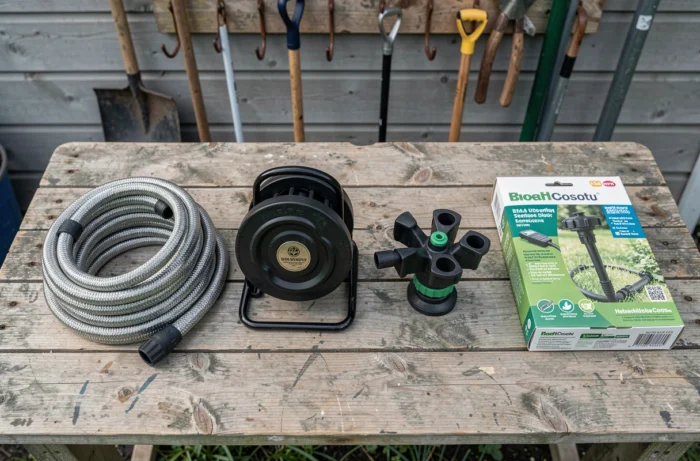
Drip irrigation Jardinic vs. micro-sprinkling Gardena: which system for a vegetable garden
In a vegetable garden, the goal is to deliver water to the base of each plant without wetting the foliage, which limits fungal diseases. Drip irrigation remains the most suitable technique.
Jardinic offers self-regulating drippers integrated into the hose, spaced regularly. The advantage: you unroll, connect, and it’s operational in less than an hour. Gardena, on the other hand, relies on a modular system (Micro-Drip) where individual drippers are inserted into a main hose. The flexibility is greater for irregular plantings, but the assembly takes significantly more time and multiplies the connection points that may leak.
Micro-sprinkling, often praised for flower beds, is not ideal for vegetable gardens. It wets the leaves of tomatoes and zucchinis, promoting downy mildew and powdery mildew. It is reserved for ornamental beds or evergreen hedges.
Compatibility with a rainwater harvesting tank
Connecting a drip irrigation kit to a rainwater harvesting tank raises the issue of gravitational pressure. Without a pump, you rarely get more than 0.5 bar. Jardinic’s self-regulating drippers require a minimum pressure to function properly, and feedback on this point varies depending on the exact model.
Gardena sells a specific submersible pump for rainwater tanks, compatible with its entire Micro-Drip range. Planning for a backup pump if the tank supplies more than ten drippers remains a rule of thumb, regardless of the brand.
Irrigation timer: reliability and drought restrictions
Since the summer of 2026, prefectural orders for water restrictions have multiplied in many French departments. Non-compliance with these orders exposes individuals to a 5th class fine of up to 1,500 euros, and up to 3,000 euros in case of repeat offenses. Consulting the VigiEau platform before scheduling your irrigation slots is no longer optional.
A reliable timer allows you to respect these time slots without thinking about it. The criteria that matter:
- Number of independent outlets: one outlet is sufficient for a vegetable garden, but at least two are needed if lawn and flower beds coexist with different needs
- Precision of the time slot: some low-end timers round to the nearest quarter-hour, wasting water when the order only allows a 45-minute window in the morning
- Battery life: a timer that runs out of battery in the middle of summer leaves the garden without water for several days, until you notice
Jardinic equips its timers with a low battery indicator visible without opening the case. Gardena offers connected models (Smart System) that can be controlled from a smartphone, with real-time alerts. The connectivity of Gardena justifies its higher cost if you are frequently away.
Durability of fittings and replacement costs over three seasons
The price of an irrigation kit is not just what you see on the initial purchase label. It is calculated over three seasons, considering the fittings to be replaced, drippers clogged by limescale, and seals that dry out in the sun.
Jardinic fittings use UV-treated plastic, a detail that may seem trivial but makes a difference after two summers of exposure. In entry-level brands sold in supermarkets, the fittings yellow and weaken by the second year. You end up repurchasing the complete kit, which negates the initial savings.
Rain Bird and Hunter, positioned in the professional segment, offer components made of brass or high-density technical plastic. Their lifespan far exceeds that of consumer ranges, but the initial investment is proportional.
- Entry-level (store brands): low purchase cost, frequent replacement of fittings and seals
- Mid-range (Jardinic, Gardena): good compromise between price and longevity, spare parts available
- Professional (Rain Bird, Hunter): designed to last more than five seasons without intervention, but installation is more technical
The choice also depends on the availability of spare parts. Jardinic and Gardena distribute their consumables in garden centers and online. For Rain Bird, you often go through specialized retailers or professional installers.
Before deciding between these brands, the most useful thing is to list your actual constraints: area to cover, available pressure, frequency of absence in summer, and desired comfort level in daily management. A well-sized system with solid fittings will provide more service than a high-end kit poorly suited to your land.