
Garlic manure is a liquid preparation obtained by prolonged maceration of garlic cloves in water. The sulfur compounds released during fermentation, particularly allicin, give this liquid repellent and antifungal properties that can be utilized in both vegetable gardens and ornamental gardens.
Allicin and sulfur compounds: what makes garlic manure active
Garlic naturally contains sulfur molecules stored in its cells. When the cloves are crushed or cut, an enzyme transforms these precursors into allicin, the compound responsible for the characteristic smell.
Related reading : How to Successfully Design Your Green Spaces for a Harmonious Garden
When immersed in water, this allicin diffuses slowly and acts on two fronts. It disrupts the development of certain microscopic fungi (downy mildew, powdery mildew) by altering their cell membranes. It also acts as an olfactory repellent against several garden pests, particularly aphids and flies.
Recent observations even suggest that the sulfur compounds in garlic disrupt the reproductive behavior of mosquitoes and flies, which extends the interest of this preparation beyond just a temporary repellent effect. To understand how to make garlic manure in the garden with maximum efficiency, this biochemical dimension changes the way the recipe is approached.
You may also like : How to Easily Make a Wooden Mashrabiya to Decorate Your Interior
One point deserves to be emphasized: allicin is unstable and degrades quickly with heat. Cold maceration, characteristic of manure, better preserves these molecules than a decoction brought to a boil. The choice between manure and decoction is therefore not trivial.
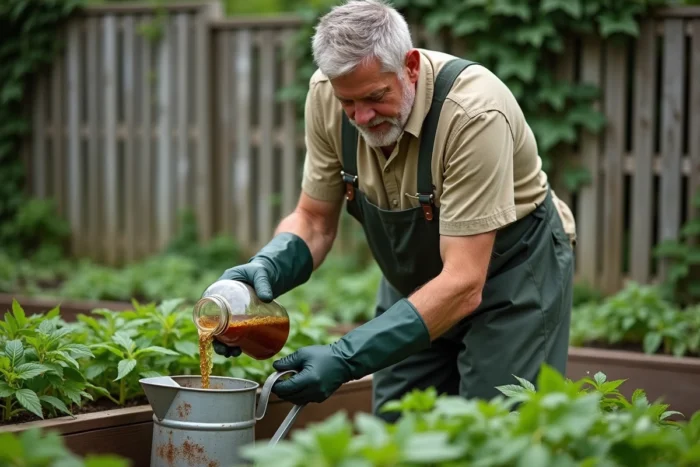
Garlic manure, decoction, maceration: which preparation to choose
These three terms refer to distinct processes that do not produce the same result.
- Garlic manure results from several days of fermentation in non-chlorinated water. The crushed cloves macerate until the liquid no longer produces bubbles on the surface, indicating that fermentation is complete. This method releases a wide range of sulfur compounds.
- The decoction involves boiling the cloves in water for about twenty minutes, then allowing it to cool. The extraction is quick, but the heat destroys some of the allicin. The result is more concentrated in other substances, useful against certain fungal diseases.
- Cold maceration consists of soaking crushed garlic in cold water for only a few hours, without fermentation. The resulting product is less potent but can be used immediately for emergency treatment.
For regular preventive use in the vegetable garden, fermented manure remains the most versatile preparation. The decoction is more suitable when a fungal problem has already been identified and quick treatment is required.
Garlic manure recipe: water, dosage, and fermentation
The quality of the water directly affects the success of the fermentation. The most recent practical guides emphasize the use of rainwater or spring water, non-chlorinated. The chlorine present in tap water inhibits the proliferation of microorganisms responsible for fermentation and reduces the concentration of active ingredients in the finished product.
Crush the garlic cloves coarsely before immersing them in water. Fine grinding accelerates the release of allicin, but simple crushing with a pestle is sufficient. Place the container (food-grade plastic or wood, never metal) in a shaded and temperate location.
Stir the mixture once a day. Bubbles appear on the surface during active fermentation. When they stop, the manure is ready to be filtered. The duration varies according to the ambient temperature: the warmer it is, the faster the fermentation.
Common mistake regarding dilution
Using pure manure on plants is a common mistake. A dosage that is too concentrated causes leaf burns, especially on young tomato and cucurbit plants. Recent guides recommend a minimum dilution of one part manure to nine parts water before spraying. On particularly sensitive foliage (roses, young seedlings), an even stronger dilution is preferable.

Preventive treatment against downy mildew and pests: when to spray
The effectiveness of garlic manure varies significantly depending on the timing of application. The most reliable field reports converge on one point: garlic manure works much better preventively than curatively. When applied before the appearance of downy mildew or powdery mildew symptoms, it slows the progression of these diseases. Once the leaves are heavily affected, the effect becomes marginal.
Preferably spray early in the morning or late in the day, when the sun is not directly on the leaves. Direct contact between sulfur compounds and strong sunlight can cause burns, even with correct dilution.
Frequency and storage
On tomatoes and cucurbits, an application every ten to fifteen days during humid periods is a reasonable rhythm. There is no need to spray in the rain: the product would be washed away before it can act.
Filtered manure can be stored in an opaque, sealed container, away from heat. The smell intensifies over time, which is normal. If surface mold appears or if the smell turns to outright rot, the preparation is unusable.
Combining garlic manure with other preparations in the garden
Garlic manure does not cover all the needs of the soil and plants. It does not provide significant amounts of nitrogen or potassium. Combining it with nettle manure (rich in nitrogen) or a horsetail decoction (complementary antifungal action through silica) allows for a broader spectrum without resorting to synthetic products.
Alternate preparations rather than mixing them in the same sprayer. A treatment with garlic manure one week, followed by an application of horsetail decoction the following week, offers diversified protection against the fungal diseases of the vegetable garden.
Garlic manure does not replace good crop rotation or a living soil. It is part of a set of practices. Used alone on impoverished soil or already stressed plants, its effects remain limited. Combined with mulching, regular composting, and thoughtful plant associations, it becomes a reliable preventive tool for the gardener who wants to avoid chemical treatments.