
Creativity at work cannot be decreed by a one-off workshop or a team-building day. Energizing creativity and culture on a daily basis requires understanding what fosters it, what hinders it, and why certain practices that are often praised yield contradictory results depending on the context.
Creativity and digital tools: a documented double-edged effect
The idea that technology stimulates creativity is widely circulated in managerial discourse. Available data nuances this assumption. A study published in August 2026 in Frontiers in Psychology shows that human-computer interaction can foster creativity through psychological availability, but can also reduce it through burnout.
The mechanism works both ways: an employee who masters their digital tools gains confidence and exploratory capacity. The same employee, overwhelmed by digital demands, sees their creative capacity decline. Organizational support mitigates the negative effect but does not eliminate it.
In the cultural field, the logic is comparable. Algorithmic recommendation platforms (music, reading, podcasts) expose users to new content while trapping them in familiarity loops. Algorithms that prioritize comfort can also hinder creative breakthroughs.
Field feedback on this point diverges, and the response largely depends on how each person uses these tools. Publications like Bigre Magazine regularly explore these tensions between digital culture and intellectual stimulation.

Psychological safety and leadership: what really matters for team creativity
The competitors of this article focus on individual techniques (idea notebook, dedicated space, meditation). These approaches have their utility. However, they overlook a factor whose weight is documented: psychological safety within the team.
An environment where mistakes are punished produces conformity, not creativity. According to a publication shared by Tolerance.ca in August 2026, creativity at work increasingly depends on this psychological safety, and not just on individual motivation.
The role of direct management appears as a central lever. A study published in Frontiers in Psychology on August 25, 2026, concludes that digital leadership is positively associated with innovation behavior in tasks, which is itself linked to increased creativity among employees. In other words, a manager who supports the use of tools and protects the right to make mistakes generates more new ideas than an annual cohesion seminar.
What this changes for team-building activities
Team cohesion activities (escape room, collaborative workshop, corporate event) still hold real interest for creating connections. Their limitation: they act over a short time. If the daily managerial climate does not support intellectual risk-taking, the effect dissipates within a few days.
A well-designed corporate seminar can initiate a dynamic. It does not replace it. Daily creativity is built in the micro-interactions of work, not in an isolated event.
Artificial intelligence and employee creativity: anxiety versus self-efficacy
The adoption of generative AI in companies adds a layer of complexity. A study published on August 31, 2026, in Frontiers in Psychology identifies two opposing mechanisms:
- Replacement anxiety: employees who perceive AI as a threat to their jobs see their creativity diminish. Fear inhibits exploration.
- AI-related self-efficacy: those who learn to use AI as a work tool gain confidence and creative capacity.
- The overall effect can partially cancel out, which explains why some companies see a creative gain after adopting AI, while others observe stagnation.
This observation has direct implications for engagement and facilitation leaders. Training teams on AI is not enough if the associated anxiety is not addressed. A cohesion activity that integrates playful discovery of AI (without performance stakes) can reduce this tension.
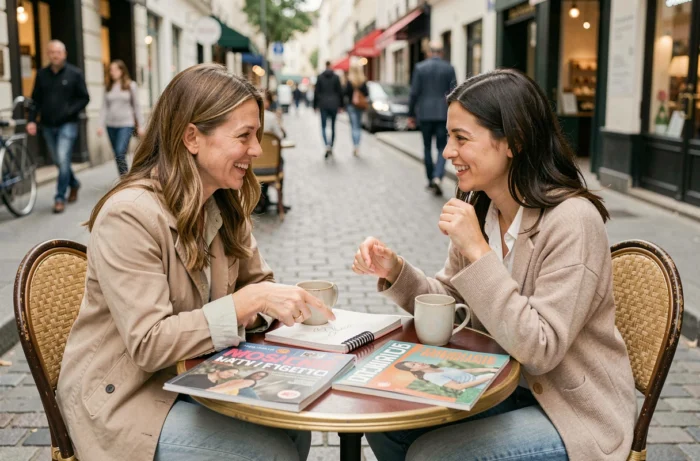
Culture in daily life: breaking out of the algorithmic loop
Energizing one’s culture requires exposure to content that does not align with one’s habits. Recommendation algorithms work in the opposite direction: they optimize immediate satisfaction, not discovery.
Some concrete practices yield measurable results:
- Alternating media (paper, podcast, video) to engage different cognitive processing modes.
- Choosing a topic each month outside of one’s professional field and sticking to it, even superficially.
- Participating in a local cultural event (exhibition, conference, workshop) at least once a quarter, to reintroduce randomness into one’s sources of inspiration.
Walking, an activity often cited for its creative benefits, is the subject of recent research. According to the Economic Times, relaying work in behavioral sciences, walking while thinking rather than sitting could help the brain generate more creative ideas. The exact mechanism remains debated, but the link between physical movement and cognitive flexibility has been documented for several years.
Creativity and culture do not function like reservoirs that are filled once and for all. They depend on a daily ecosystem made up of psychological safety, diversity of stimuli, and a controlled use of digital tools. The next lever to explore for companies is probably not a new seminar activity, but the quality of ordinary interactions between employees.