A free online rephraser is not limited to substituting synonyms. Current paraphrasing models restructure syntax, redistribute clauses, and adjust the register, altering the linguistic surface of the source text without changing its meaning. For academic work, this mechanism raises questions about both writing efficiency and academic integrity.
How an online rephraser works linguistically
Rephrasing tools rely on encoder-decoder architectures. The input text is tokenized, converted into a vector representation, and then reconstructed sentence by sentence with different vocabulary and syntax structure. The result depends on the training corpus and the selected mode (formal, fluid, concise).
We observe that most free rephrasers work well on short, isolated sentences. Quality degrades on long paragraphs containing complex logical connectors or specialized vocabulary. A sociology passage filled with concepts like “habitus” or “symbolic capital” will be rephrased with approximations that betray the original meaning.
The chosen rephrasing mode determines the depth of rewriting. A “standard” mode replaces a few terms, a “fluid” mode reorganizes clauses, and a “formal” mode adjusts the register. For a thesis or dissertation, the formal mode remains the most relevant, but each sentence must be carefully reread to ensure that terminological precision is preserved.
We recommend working sentence by sentence rather than pasting an entire paragraph, so you can compare and validate each rephrasing before integrating it into the final document. You can also learn more about Le Carolo Geek regarding concrete usage strategies in an academic context.
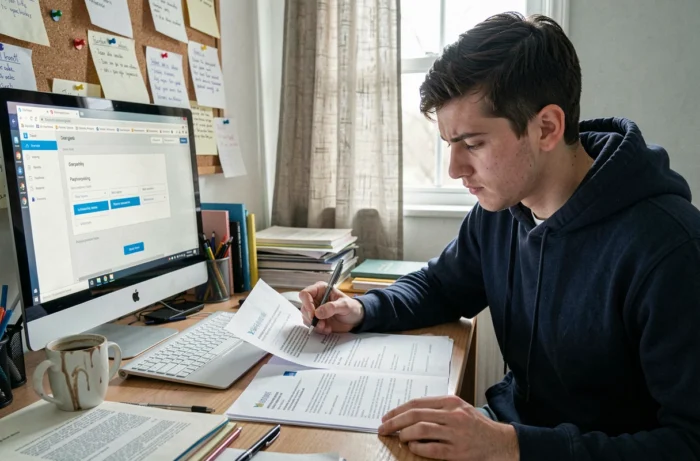
Anti-plagiarism detection and AI rephrasing: what universities detect
Anti-plagiarism software no longer simply compares strings of characters. Recent solutions incorporate modules for detecting AI-generated or rephrased content, including what specialists call deep rephrasing and disguised multilingual translation (text written in one language and then translated before rephrasing).
This evolution has direct consequences on how to use a free rephraser. A text processed by an automatic paraphrasing tool presents identifiable statistical signatures: abnormal distribution of synonyms, syntactic uniformity, and absence of natural stylistic breaks. Recent detectors exploit these markers.
Mandatory usage declaration in several institutions
An increasing number of scientific journals and doctoral schools now require an explicit declaration of the use of AI tools in manuscripts or theses. Institutions like the European University Institute treat undeclared AI content as an issue of academic integrity.
In practical terms, optimizing your work with a rephraser involves planning how to justify and document this usage. Some universities require a methodological appendix specifying which tools were used, on which passages, and for what purpose. Ignoring this requirement exposes you to disciplinary sanctions, even if the reformulated content does not constitute plagiarism in the strict sense.
- Check your institution’s internal regulations regarding the use of AI tools and rephrasers before any use
- Keep successive versions of your texts (before and after rephrasing) to justify your writing process
- Explicitly mention the tool used in the methodology section or in an authorship declaration if your institution requires it
Rephrasing an academic text without degrading terminological rigor
A rephraser does not replace mastery of disciplinary vocabulary. The main risk in academic work is not plagiarism but conceptual impoverishment. When a tool replaces “epistemological paradigm” with “frame of thought,” the text loses precision without the student realizing it.
We recommend locking in technical terms before starting the rephrasing. Most tools allow you to protect certain words or expressions from the rewriting process. This feature is underutilized, yet it radically changes the quality of the result.
Proofreading protocol after rephrasing
Automatic rephrasing regularly introduces errors of three types:
- Semantic shifts: a technical term is replaced by a near-synonym that does not fit the disciplinary context
- Breaks in textual cohesion: logical connectors between separately rephrased sentences no longer articulate correctly
- Inappropriate register: some rephrasings shift from an academic register to a journalistic or conversational register
Each rephrased passage must be proofread against the source text. The question to ask is not “is the sentence correct?” but “does this rephrasing say exactly the same thing in my disciplinary field?”.

Limitations of free rephrasers for academic writing
The free versions of rephrasing tools have restrictions that directly affect their usefulness for long works. The character limit per request forces you to break up the text, disrupting inter-sentential coherence. The number of available modes is reduced, often to one or two generic modes.
Free rephrasers do not handle embedded citations or bibliographic references. A passage containing a quoted citation will be rephrased as ordinary text, which constitutes a falsification of the source. It is imperative to extract citations before rephrasing and manually reintegrate them afterward.
The lack of contextual memory in free versions poses another problem. The tool treats each block of text independently, without considering the rest of the document. The result is a text whose style varies from one paragraph to another, which is precisely one of the signals that AI detectors exploit.
A free online rephraser remains a writing aid tool, not a substitute for the writing process. A student who uses it to refine a clumsy formulation or explore alternative phrasings gains real benefits. However, one who pastes an entire paragraph copied from a source without first understanding and mentally rephrasing it exposes themselves to both a degradation of their text and an increasing disciplinary risk.