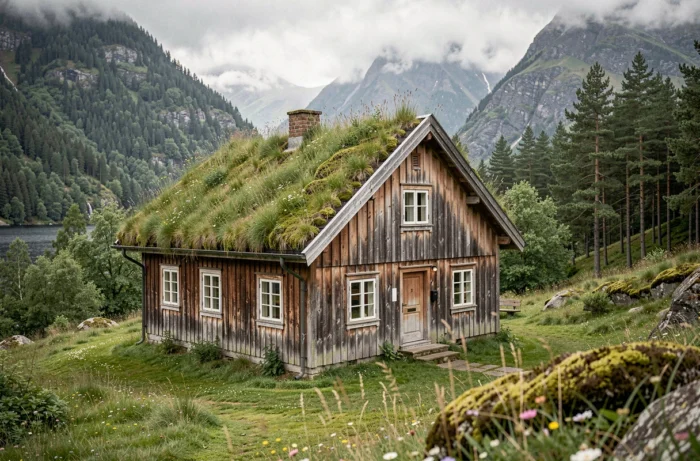
In Norway, grass-covered roofs are not a tourist curiosity. They have been part of the landscape since prehistoric times, long before the word “ecology” existed. Their current popularity is due to a rare mix: an uninterrupted architectural tradition, a climate that makes these roofs particularly effective, and urban regulations that actively encourage them.
Birch bark and grass: the ancestral technique of Norwegian roofs
Before discussing thermal insulation or rainwater management, it is essential to understand how these roofs are made. The method has not fundamentally changed since the Viking Age.
First, a wooden framework is laid, often made of pine or birch. On top of that, several layers of birch bark are spread. This natural material serves as a waterproofing agent: it prevents water from penetrating the structure. Then, soil and sod clumps are placed, roots facing up.
Why birch bark and not something else? Because this material is naturally resistant to water and decomposition. It was readily available throughout the Norwegian forests. Clay or slate tiles only began to appear on roofs in the 19th century, first in cities and on mansions. In rural areas, the grass roof remained universal until the 18th century.
Today, mountain cabins, shelters, and vacation homes are adopting this construction method. To better understand how green roofs in Norway fit into domestic architecture, one must look beyond folklore: it is a technical response to a harsh climate.
Thermal insulation and rainwater management: why green roofs work so well in the North
The Norwegian climate imposes two major constraints on any roofing: very cold winters and abundant precipitation, often in the form of snow. The green roof addresses both at the same time.
A natural insulator against the cold
The layer of soil and vegetation traps air between the roots and blades of grass. This still air acts as an insulator. In winter, the mass of soil reduces heat loss to the outside. In summer, it prevents the sun’s heat from overheating the interior.
This principle works without any energy or synthetic materials. That is why Norwegians used it long before the invention of industrial insulators.
A rainwater absorber
When it rains, a traditional tile or slate roof immediately drains water into the gutters. A green roof, on the other hand, absorbs some of that water into the substrate. The vegetation consumes another portion.
The result: the water runoff is slower and lower. During heavy rains, this retention capacity reduces pressure on drainage networks. In Norway, where precipitation is frequent and sometimes violent on the west coast, this is a tangible advantage.
Blågrønn faktor: the Norwegian regulation that mandates green surfaces
The popularity of green roofs in Norway is not solely based on tradition. Norwegian municipalities now use a regulatory tool called blågrønn faktor (blue-green factor). This coefficient mandates a minimum of ecological surfaces in new construction projects.
Specifically, before obtaining a certificate of conformity, a developer must prove that their project incorporates sufficient vegetation, rainwater management, and permeable surfaces. Green roofs are part of the accepted measures to meet this threshold.
The legal basis is Article 12-7 of the Norwegian Planning and Building Act. Detailed plans must document rainwater management, vegetation, and green surfaces. A green roof allows for multiple boxes to be checked at once:
- It retains rainwater and slows its drainage into the collective network, which meets hydraulic management requirements.
- It adds vegetated surface area to the project, directly increasing the building’s blue-green score.
- It can host local biodiversity if the planted species are native, which the regulation increasingly encourages.
This regulatory framework explains why green roofs are no longer reserved for mountain cabins. They are also appearing on recent urban buildings, including in major Norwegian cities.
Native plants versus sedum: the ecological evolution of Norwegian green roofs
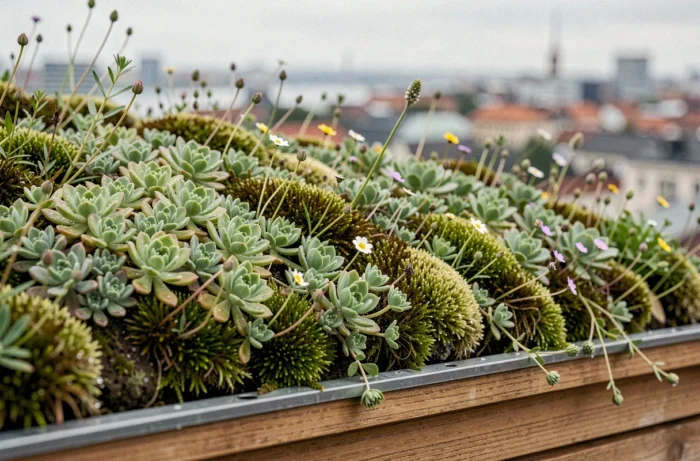
For a long time, modern vegetated roofs in Europe were almost exclusively covered with sedum. This succulent plant is resilient, lightweight, and requires very little maintenance. It remains the default choice in most countries.
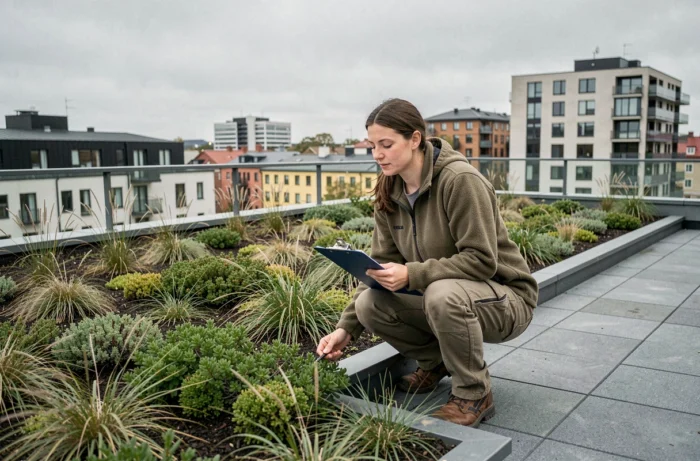
In Norway, recent research is pushing in a different direction. Studies relayed by researcher Jørgen Tycho show that diverse mixtures of native species outperform sedum monocultures on several criteria: vegetation cover, cooling effect, and carbon assimilation.
Why this result? A mixture of plants with varying root depths better exploits the substrate. Some species capture water at the surface, while others do so deeper down. Their staggered growth cycles ensure a longer green cover throughout the year.
This approach aligns with the logic of traditional grass roofs, which have never been monocultures. The sod clumps taken from meadows naturally contained dozens of different plant species. Contemporary research, in essence, validates what ancestral practice had already established.
Ecological architecture in Norway: between Viking heritage and sustainable construction
Norwegian green roofs illustrate a rare continuity in architecture. The same construction principle has traversed the centuries because it works. Local wood provides the framework, birch bark ensures waterproofing, soil and grass insulate and protect.
Contemporary Norwegian architects do not reproduce this tradition out of nostalgia. They adapt it with modern waterproofing membranes, calibrated substrates, and integrated drainage systems. The principle remains the same; only the accompanying materials change.
- Mountain cabins often retain the traditional method with birch bark, for both aesthetic and practical reasons.
- Urban buildings use synthetic membranes beneath the substrate, compatible with current construction standards.
- The most recent projects incorporate sensors to measure water retention and the thermal performance of the roof in real time.
The popularity of these roofs in Norway stems from this combination: a know-how that dates back to prehistoric times, a climate that makes the solution effective without artifice, and a regulatory framework that transforms a tradition into an obligation in new projects. Few construction techniques can claim such coherence between past and present.