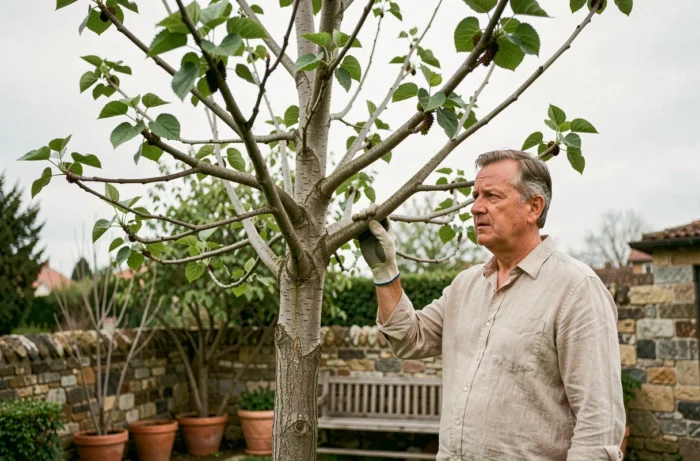
The plane tree mulberry that does not bear fruit is not necessarily sick or poorly maintained. In most cases, the absence of fruit is a deliberate varietal characteristic, encoded in the genome of the cultivar sold in nurseries. Before looking for cultural causes, the first question to ask concerns the exact identity of the planted tree.
Morus kagayamae ‘Fruitless’: identifying a sterile cultivar before looking for a problem
The term “plane tree mulberry” encompasses several botanical names and horticultural synonyms that create confusion. Depending on the labels, you may find Morus kagayamae, Morus platanifolia, or Morus australis, without the customer always being able to distinguish a fertile form from a sterile cultivar.
The cultivar ‘Fruitless’, as its name suggests, has been selected to never produce blackberries. We regularly observe disappointed gardeners during consultations due to the lack of harvest when they have unknowingly purchased a tree specifically designed for this purpose.
This varietal choice meets a specific urban use. The blackberries from the mulberry tree are very staining: they soil terraces, pavements, pool surroundings, and car bodies. Nurserymen therefore heavily steer towards sterile forms when the main goal is shading. If you purchased your tree from a general garden center to shade a terrace, the likelihood of having a sterile cultivar is high.
The only reliable way to determine this is to find the original varietal label or to contact the supplying nursery. Before considering whether the fruits of the plane tree mulberry are edible or not deserve to be harvested, you must first verify that your specimen is genetically capable of producing them.
Fertile plane tree mulberry without fruit: cultural causes to check
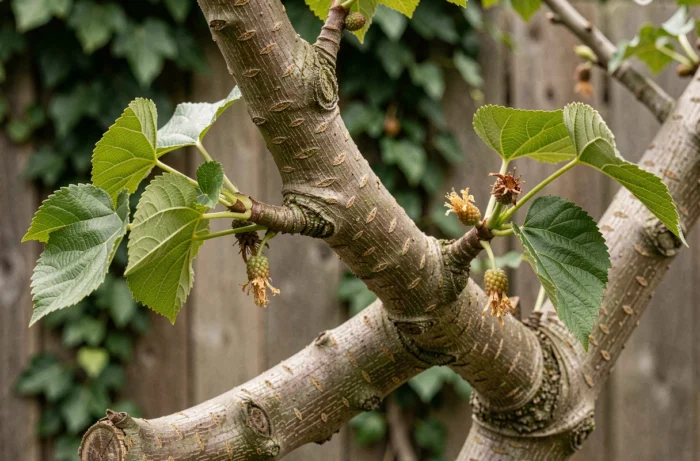
If your tree is indeed a fertile form (Morus kagayamae type, not ‘Fruitless’), several factors explain the absence of fruiting.
Youth of the specimen
A plane tree mulberry from grafting generally takes a few years after planting before it fruits. A recently planted specimen focuses its energy on rooting and developing its framework. Patience is the only answer at this stage.
Imbalance in nitrogen fertilization
An excess of nitrogen promotes vegetative growth at the expense of fruiting. The foliage develops abundantly, the shoots elongate, but the tree does not trigger flowering. We recommend suspending any nitrogen input (fresh manure, lawn fertilizer, young compost) at the base of the tree and prioritizing a potash amendment at the end of winter, which supports flowering.
Water stress or waterlogging
The plane tree mulberry tolerates drought well once established, but severe water stress during the flowering period causes flower drop. Conversely, constantly waterlogged soil suffocates the roots and disrupts the tree’s physiology. A draining soil, free of standing water, remains essential.
Excessive pruning at the wrong time
Severe pruning at the end of winter, systematically done to maintain a parasol shape, removes part of the branches that bear floral buds. The mulberry fruits on the wood of the previous year. Pruning too short each year amounts to removing the flowering potential.
- Limit maintenance pruning to dead, poorly oriented branches or those that unbalance the canopy
- Retain one-year-old branches that bear future floral buds
- Intervene at the end of winter, before bud break, with moderate pruning rather than severe cutting back
Late frosts and flowering of the plane tree mulberry
The plane tree mulberry buds relatively late in spring, which partially protects it from frosts. A late frost episode occurring after the appearance of the floral catkins destroys the flowering without visibly damaging the foliage. The tree appears healthy, but no fruit forms.
The absence of fruit in a single year points to a climatic accident rather than a structural problem. If the phenomenon repeats every year, the cause lies elsewhere (sterile cultivar, inappropriate pruning, excess nitrogen).
In areas where spring frosts are recurrent, we observe that specimens planted in sheltered situations (against a south or southwest-facing wall) fruit more regularly than those in open wind. The thermal radiation from the wall protects the floral buds during cold nights.

Shading and fruiting: balancing between parasol and harvest
The plane tree mulberry is primarily a shade tree. Its parasol shape, with a short trunk and a wide crown, is the most common form in Mediterranean gardens and urban courtyards. This shape involves regular pruning that mechanically reduces fruiting.
If the goal is to harvest blackberries, one must accept a freer form, with lateral branches that naturally elongate. The canopy will be less compact, the shade less dense, but fruit production will significantly increase.
- Maximum shading goal: choose a sterile cultivar, prune in parasol shape without constraints
- Mixed goal (shade and fruit): fertile cultivar, gentle pruning limited to dead wood and balancing
- Harvest goal: fertile cultivar, free or open goblet shape, no annual cutting back
Wanting a perfect parasol and an abundant harvest on the same tree is contradictory. The choice of shape determines the outcome. It is better to decide clearly at planting rather than seeking a shaky compromise that will satisfy neither goal.
A fertile plane tree mulberry, planted in draining soil, correctly exposed, pruned with restraint, and nourished without excess nitrogen, will eventually bear fruit. If nothing comes after several seasons, the answer is almost always on the nursery label.